Current section
Files
Jump to
Current section
Files
README.md
# OMQ.beam
BEAM bindings for OMQ, backed by `omq-tokio`.
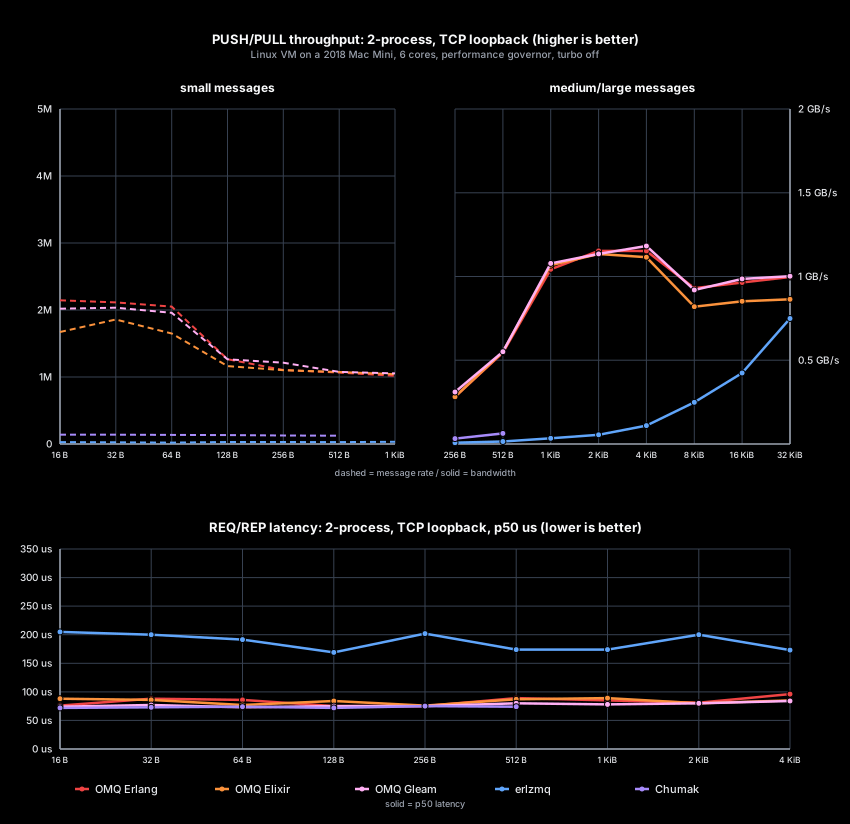
Erlang is the base binding. Elixir and Gleam are thin wrappers over the same
Erlang module and NIF, so one Rust native library serves all three languages.
Architecture detail: [`doc/architecture.md`](doc/architecture.md).
Benchmarks compare the three OMQ wrappers against `erlzmq` and `chumak`.
`exzmq` is not included because its current public API is CLIENT/SERVER-only.
## Install
Erlang:
```erlang
{deps, [{omq, "0.1.0"}]}.
```
Elixir:
```elixir
def deps do
[{:omq_elixir, "~> 0.1"}]
end
```
Gleam:
```toml
[dependencies]
omq_gleam = ">= 0.1.0 and < 1.0.0"
```
## API Shape
- `omq:context(...)` owns native IO threads and creates sockets.
- Erlang is the base API. Elixir and Gleam wrappers keep the same native
context and `inproc://` namespace through explicit share keys.
- Socket resources cover all 20 ZMQ socket types and use normal endpoint
strings for bind/connect.
- Message calls support binaries, strings, Erlang terms, JSON, multipart, and
nonblocking variants.
- Pub/sub controls, RADIO/DISH groups, polling, monitoring, proxies, and core
libzmq-compatible options are exposed through the Erlang module.
- Treat each socket as owned by one BEAM process. This matches actor-style
sequencing and keeps multipart frame state local to the caller.
- Create more sockets for more concurrent flows; share contexts when wrappers
need the same `inproc://` namespace.
Example:
```erlang
{ok, Ctx} = omq:context(),
{ok, Pull} = omq:socket(Ctx, pull),
{ok, Push} = omq:socket(Ctx, push),
{ok, Endpoint} = omq:bind(Pull, <<"tcp://127.0.0.1:0">>),
ok = omq:connect(Push, Endpoint),
ok = omq:send(Push, <<"hello">>),
{ok, <<"hello">>} = omq:recv(Pull, 1000),
ok = omq:close(Push),
ok = omq:close(Pull),
ok = omq:term(Ctx).
```
Development commands: [`DEVELOPMENT.md`](DEVELOPMENT.md).