Current section
Files
Jump to
Current section
Files
lib/matrex.ex
defmodule Matrex do
@moduledoc """
Performs fast operations on matrices using native C code and CBLAS library.
## Access behaviour
Access behaviour is partly implemented for Matrex, so you can do:
```elixir
iex> m = Matrex.magic(3)
#Matrex[3×3]
┌ ┐
│ 8.0 1.0 6.0 │
│ 3.0 5.0 7.0 │
│ 4.0 9.0 2.0 │
└ ┘
iex> m[2][3]
7.0
```
Or even:
```elixir
iex> m[1..2]
#Matrex[2×3]
┌ ┐
│ 8.0 1.0 6.0 │
│ 3.0 5.0 7.0 │
└ ┘
```
There are also several shortcuts for getting dimensions of matrix:
```elixir
iex> m[:rows]
3
iex> m[:size]
{3, 3}
```
calculating maximum value of the whole matrix:
```elixir
iex> m[:max]
9.0
```
or just one of it's rows:
```elixir
iex> m[2][:max]
7.0
```
calculating one-based index of the maximum element for the whole matrix:
```elixir
iex> m[:argmax]
8
```
and a row:
```elixir
iex> m[2][:argmax]
3
```
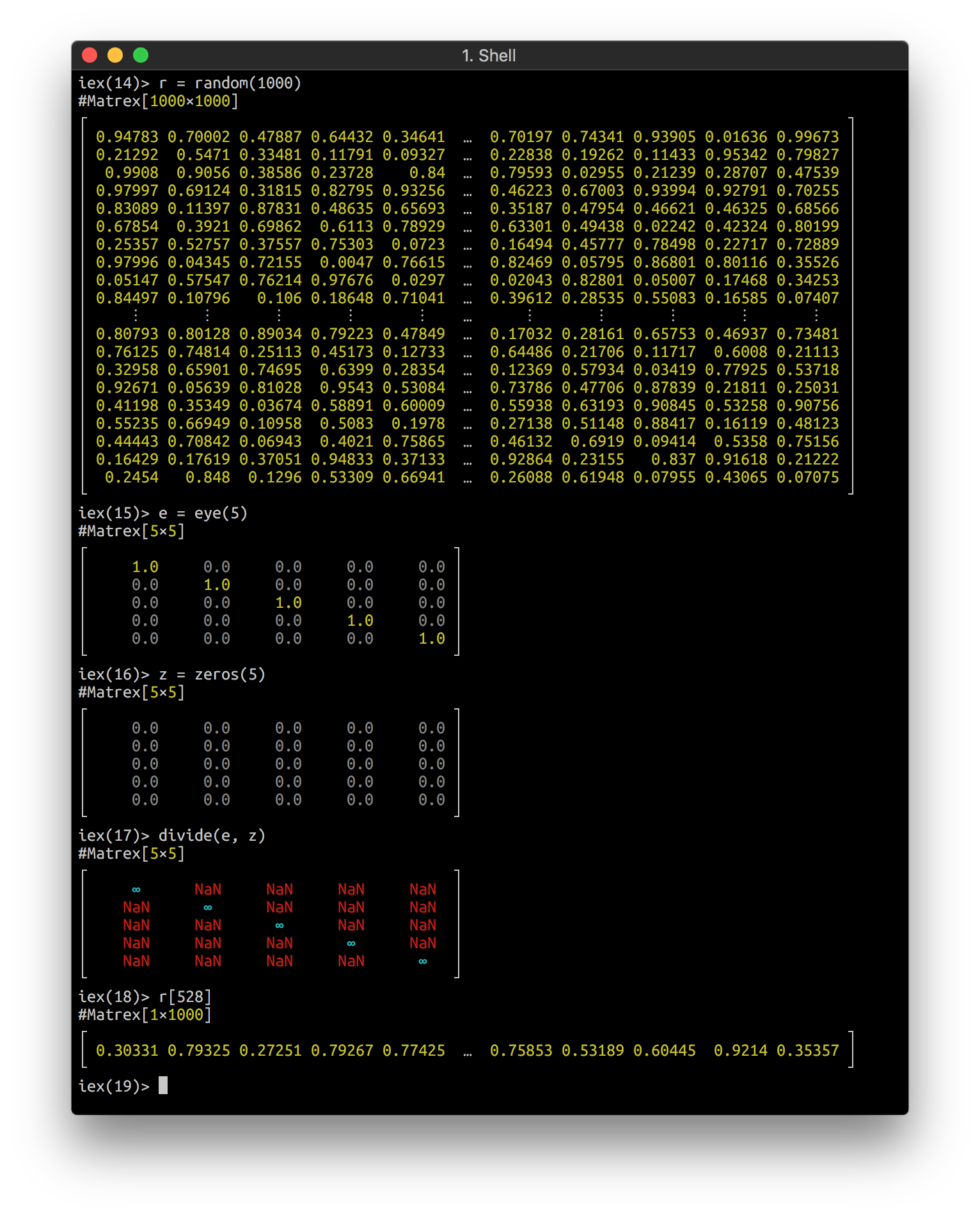
## Inspect protocol
Matrex implements `Inspect` and looks nice in your console:
## Math operators overloading
`Matrex.Operators` module redefines `Kernel` math operators (+, -, *, / <|>) and
defines some convenience functions, so you can write calculations code in more natural way.
It should be used with great caution. We suggest using it only inside specific functions
and only for increased readability, because using `Matrex` module functions, especially
ones which do two or more operations at one call, are 2-3 times faster.
### Example
```elixir
def lr_cost_fun_ops(%Matrex{} = theta, {%Matrex{} = x, %Matrex{} = y, lambda} = _params)
when is_number(lambda) do
# Turn off original operators
import Kernel, except: [-: 1, +: 2, -: 2, *: 2, /: 2, <|>: 2]
import Matrex.Operators
import Matrex
m = y[:rows]
h = sigmoid(x * theta)
l = ones(size(theta)) |> set(1, 1, 0.0)
j = (-t(y) * log(h) - t(1 - y) * log(1 - h) + lambda / 2 * t(l) * pow2(theta)) / m
grad = (t(x) * (h - y) + (theta <|> l) * lambda) / m
{scalar(j), grad}
end
```
The same function, coded with module methods calls (2.5 times faster):
```elixir
def lr_cost_fun(%Matrex{} = theta, {%Matrex{} = x, %Matrex{} = y, lambda} = _params)
when is_number(lambda) do
m = y[:rows]
h = Matrex.dot_and_apply(x, theta, :sigmoid)
l = Matrex.ones(theta[:rows], theta[:cols]) |> Matrex.set(1, 1, 0)
regularization =
Matrex.dot_tn(l, Matrex.square(theta))
|> Matrex.scalar()
|> Kernel.*(lambda / (2 * m))
j =
y
|> Matrex.dot_tn(Matrex.apply(h, :log), -1)
|> Matrex.subtract(
Matrex.dot_tn(
Matrex.subtract(1, y),
Matrex.apply(Matrex.subtract(1, h), :log)
)
)
|> Matrex.scalar()
|> (fn
:nan -> :nan
x -> x / m + regularization
end).()
grad =
x
|> Matrex.dot_tn(Matrex.subtract(h, y))
|> Matrex.add(Matrex.multiply(theta, l), 1.0, lambda)
|> Matrex.divide(m)
{j, grad}
end
```
## Enumerable protocol
Matrex implements `Enumerable`, so, all kinds of `Enum` functions are applicable:
```elixir
iex> Enum.member?(m, 2.0)
true
iex> Enum.count(m)
9
iex> Enum.sum(m)
45
```
For functions, that exist both in `Enum` and in `Matrex` it's preferred to use Matrex
version, beacuse it's usually much, much faster. I.e., for 1 000 x 1 000 matrix `Matrex.sum/1`
and `Matrex.to_list/1` are 438 and 41 times faster, respectively, than their `Enum` counterparts.
## Saving and loading matrix
You can save/load matrix with native binary file format (extra fast)
and CSV (slow, especially on large matrices).
Matrex CSV format is compatible with GNU Octave CSV output,
so you can use it to exchange data between two systems.
### Example
```elixir
iex> Matrex.random(5) |> Matrex.save("rand.mtx")
:ok
iex> Matrex.load("rand.mtx")
#Matrex[5×5]
┌ ┐
│ 0.05624 0.78819 0.29995 0.25654 0.94082 │
│ 0.50225 0.22923 0.31941 0.3329 0.78058 │
│ 0.81769 0.66448 0.97414 0.08146 0.21654 │
│ 0.33411 0.59648 0.24786 0.27596 0.09082 │
│ 0.18673 0.18699 0.79753 0.08101 0.47516 │
└ ┘
iex> Matrex.magic(5) |> Matrex.divide(Matrex.eye(5)) |> Matrex.save("nan.csv")
:ok
iex> Matrex.load("nan.csv")
#Matrex[5×5]
┌ ┐
│ 16.0 ∞ ∞ ∞ ∞ │
│ ∞ 4.0 ∞ ∞ ∞ │
│ ∞ ∞ 12.0 ∞ ∞ │
│ ∞ ∞ ∞ 25.0 ∞ │
│ ∞ ∞ ∞ ∞ 8.0 │
└ ┘
```
## NaN and Infinity
Float special values, like `:nan` and `:inf` live well inside matrices,
can be loaded from and saved to files.
But when getting them into Elixir they are transferred to `:nan`,`:inf` and `:neg_inf` atoms,
because BEAM does not accept special values as valid floats.
```elixir
iex> m = Matrex.eye(3)
#Matrex[3×3]
┌ ┐
│ 1.0 0.0 0.0 │
│ 0.0 1.0 0.0 │
│ 0.0 0.0 1.0 │
└ ┘
iex> n = Matrex.divide(m, Matrex.zeros(3))
#Matrex[3×3]
┌ ┐
│ ∞ NaN NaN │
│ NaN ∞ NaN │
│ NaN NaN ∞ │
└ ┘
iex> n[1][1]
:inf
iex> n[1][2]
:nan
```
"""
alias Matrex.NIFs
import Matrex.Guards
@enforce_keys [:data]
defstruct [:data]
@type element :: number | :nan | :inf | :neg_inf
@type index :: pos_integer
@type matrex :: %Matrex{data: binary}
@type t :: matrex
# Size of matrix element (float) in bytes
@element_size 4
# Float special values in binary form
@not_a_number <<0, 0, 192, 255>>
@positive_infinity <<0, 0, 128, 127>>
@negative_infinity <<0, 0, 128, 255>>
@compile {:inline,
add: 2,
argmax: 1,
at: 3,
binary_to_float: 1,
column_to_list: 2,
contains?: 2,
divide: 2,
dot: 2,
dot_and_add: 3,
dot_nt: 2,
dot_tn: 2,
eye: 1,
element_to_string: 1,
fill: 3,
fill: 2,
first: 1,
fetch: 2,
float_to_binary: 1,
max: 1,
multiply: 2,
ones: 2,
ones: 1,
parse_float: 1,
random: 2,
random: 1,
reshape: 3,
row_to_list: 2,
row: 2,
set: 4,
size: 1,
square: 1,
subtract: 2,
subtract_inverse: 2,
sum: 1,
to_list: 1,
to_list_of_lists: 1,
to_row: 1,
to_column: 1,
transpose: 1,
update: 4,
zeros: 2,
zeros: 1}
@behaviour Access
# Horizontal vector
@doc false
@impl Access
def fetch(
%Matrex{
data: <<
rows::unsigned-integer-little-32,
_columns::unsigned-integer-little-32,
_rest::binary
>>
} = matrex,
key
)
when is_integer(key) and key > 0 and rows == 1,
do: {:ok, at(matrex, 1, key)}
# Vertical vector
@impl Access
def fetch(
%Matrex{
data: <<
_rows::unsigned-integer-little-32,
columns::unsigned-integer-little-32,
_rest::binary
>>
} = matrex,
key
)
when is_integer(key) and key > 0 and columns == 1,
do: {:ok, at(matrex, key, 1)}
# Return a row
@impl Access
def fetch(
%Matrex{} = matrex,
key
)
when is_integer(key) and key > 0,
do: {:ok, row(matrex, key)}
@impl Access
def fetch(
%Matrex{
data: <<
1::unsigned-integer-little-32,
columns::unsigned-integer-little-32,
data::binary
>>
},
a..b
)
when b > a and a > 0 and b <= columns,
do:
{:ok,
%Matrex{
data:
<<1::unsigned-integer-little-32, b - a + 1::unsigned-integer-little-32,
binary_part(data, (a - 1) * @element_size, (b - a + 1) * @element_size)::binary>>
}}
@impl Access
def fetch(
%Matrex{
data: <<
rows::unsigned-integer-little-32,
columns::unsigned-integer-little-32,
data::binary
>>
},
a..b
)
when b > a and a > 0 and b <= rows,
do:
{:ok,
%Matrex{
data:
<<b - a + 1::unsigned-integer-little-32, columns::unsigned-integer-little-32,
binary_part(
data,
(a - 1) * columns * @element_size,
(b - a + 1) * columns * @element_size
)::binary>>
}}
@impl Access
def fetch(
%Matrex{
data: <<
rows::unsigned-integer-little-32,
_columns::unsigned-integer-little-32,
_rest::binary
>>
},
:rows
),
do: {:ok, rows}
@impl Access
def fetch(
%Matrex{
data: <<
_rows::unsigned-integer-little-32,
columns::unsigned-integer-little-32,
_rest::binary
>>
},
:cols
),
do: {:ok, columns}
@impl Access
def fetch(
%Matrex{
data: <<
_rows::unsigned-integer-little-32,
columns::unsigned-integer-little-32,
_rest::binary
>>
},
:columns
),
do: {:ok, columns}
@impl Access
def fetch(
%Matrex{
data: <<
rows::unsigned-integer-little-32,
columns::unsigned-integer-little-32,
_rest::binary
>>
},
:size
),
do: {:ok, {rows, columns}}
@impl Access
def fetch(%Matrex{} = matrex, :sum), do: {:ok, sum(matrex)}
def fetch(%Matrex{} = matrex, :max), do: {:ok, max(matrex)}
def fetch(%Matrex{} = matrex, :min), do: {:ok, min(matrex)}
def fetch(%Matrex{} = matrex, :argmax), do: {:ok, argmax(matrex)}
@doc false
@impl Access
def get(%Matrex{} = matrex, key, default) do
case fetch(matrex, key) do
{:ok, value} -> value
:error -> default
end
end
@doc false
@impl Access
def pop(
%Matrex{
data:
<<rows::unsigned-integer-little-32, columns::unsigned-integer-little-32,
body::binary>>
},
row
)
when is_integer(row) and row >= 1 and row <= rows do
{%Matrex{
data:
<<1::unsigned-integer-little-32, columns::unsigned-integer-little-32,
binary_part(body, (row - 1) * columns * @element_size, columns * @element_size)::binary>>
},
%Matrex{
data:
<<rows - 1::unsigned-integer-little-32, columns::unsigned-integer-little-32,
binary_part(body, 0, (row - 1) * columns * @element_size)::binary,
binary_part(
body,
row * columns * @element_size,
(rows - row) * columns * @element_size
)::binary>>
}}
end
def pop(%Matrex{} = matrex, _), do: {nil, matrex}
# To silence warnings
@doc false
@impl Access
def get_and_update(%Matrex{}, _row, _fun), do: :not_implemented
defimpl Inspect do
@doc false
def inspect(%Matrex{} = matrex, opts) do
columns =
case opts.width do
:infinity -> 80
width -> width
end
Matrex.Inspect.do_inspect(matrex, columns, 21)
end
end
defimpl Enumerable do
# Matrix element size in bytes
@element_size 4
@doc false
def count(%Matrex{
data:
<<rows::unsigned-integer-little-32, cols::unsigned-integer-little-32, _body::binary>>
}),
do: {:ok, rows * cols}
@doc false
def member?(%Matrex{} = matrex, element), do: {:ok, Matrex.contains?(matrex, element)}
@doc false
def slice(%Matrex{
data:
<<rows::unsigned-integer-little-32, cols::unsigned-integer-little-32, body::binary>>
}),
do:
{:ok, rows * cols,
fn start, length ->
Matrex.binary_to_list(
binary_part(body, start * @element_size, length * @element_size)
)
end}
@doc false
def reduce(
%Matrex{
data:
<<_rows::unsigned-integer-little-32, _cols::unsigned-integer-little-32,
body::binary>>
},
{:cont, acc},
fun
),
do: reduce(body, {:cont, acc}, fun)
def reduce(_, {:halt, acc}, _fun), do: {:halted, acc}
def reduce(<<matrix::binary>>, {:suspend, acc}, fun),
do: {:suspended, acc, &reduce(matrix, &1, fun)}
def reduce(<<elem::binary-4, rest::binary>>, {:cont, acc}, fun),
do: reduce(rest, fun.(Matrex.binary_to_float(elem), acc), fun)
def reduce(<<>>, {:cont, acc}, _fun), do: {:done, acc}
end
@doc """
Adds scalar to matrix.
See `Matrex.add/4` for details.
"""
@spec add(matrex, number) :: matrex
@spec add(number, matrex) :: matrex
def add(%Matrex{data: matrix} = _a, b) when is_number(b),
do: %Matrex{data: NIFs.add_scalar(matrix, b)}
def add(a, %Matrex{data: matrix} = _b) when is_number(a),
do: %Matrex{data: NIFs.add_scalar(matrix, a)}
@doc """
Adds two matrices or scalar to each element of matrix. NIF.
Can optionally scale any of the two matrices.
C = αA + βB
Raises `ErlangError` if matrices' sizes do not match.
## Examples
iex> Matrex.add(Matrex.new([[1,2,3],[4,5,6]]), Matrex.new([[7,8,9],[10,11,12]]))
#Matrex[2×3]
┌ ┐
│ 8.0 10.0 12.0 │
│ 14.0 16.0 18.0 │
└ ┘
Adding with scalar:
iex> m = Matrex.magic(3)
#Matrex[3×3]
┌ ┐
│ 8.0 1.0 6.0 │
│ 3.0 5.0 7.0 │
│ 4.0 9.0 2.0 │
└ ┘
iex> Matrex.add(m, 1)
#Matrex[3×3]
┌ ┐
│ 9.0 2.0 7.0 │
│ 4.0 6.0 8.0 │
│ 5.0 10.0 3.0 │
└ ┘
With scaling each matrix:
iex> Matrex.add(Matrex.new("1 2 3; 4 5 6"), Matrex.new("3 2 1; 6 5 4"), 2.0, 3.0)
#Matrex[2×3]
┌ ┐
│ 11.0 10.0 9.0 │
│ 26.0 25.0 24.0 │
└ ┘
"""
@spec add(matrex, matrex, number, number) :: matrex
def add(
%Matrex{
data:
<<rows::unsigned-integer-little-32, columns::unsigned-integer-little-32,
_data1::binary>> = first
},
%Matrex{
data:
<<rows::unsigned-integer-little-32, columns::unsigned-integer-little-32,
_data2::binary>> = second
},
alpha \\ 1.0,
beta \\ 1.0
)
when is_number(alpha) and is_number(beta),
do: %Matrex{data: NIFs.add(first, second, alpha, beta)}
@doc """
Applies given function to each element of the matrix and returns the matrex of results. NIF.
If second argument is an atom, then applies C language math function.
## Example
iex> Matrex.magic(5) |> Matrex.apply(:sigmoid)
#Matrex[5×5]
┌ ┐
│-0.95766-0.53283 0.28366 0.7539 0.13674 │
│-0.99996-0.65364 0.96017 0.90745 0.40808 │
│-0.98999-0.83907 0.84385 0.9887-0.54773 │
│-0.91113 0.00443 0.66032 0.9912-0.41615 │
│-0.75969-0.27516 0.42418 0.5403 -0.1455 │
└ ┘
The following math functions from C <math.h> are supported, and also a sigmoid function:
```elixir
:exp, :exp2, :sigmoid, :expm1, :log, :log2, :sqrt, :cbrt, :ceil, :floor, :truncate, :round,
:abs, :sin, :cos, :tan, :asin, :acos, :atan, :sinh, :cosh, :tanh, :asinh, :acosh, :atanh,
:erf, :erfc, :tgamma, :lgamm
```
If second argument is a function that takes one argument,
then this function receives the element of the matrix.
## Example
iex> Matrex.magic(5) |> Matrex.apply(&:math.cos/1)
#Matrex[5×5]
┌ ┐
│-0.95766-0.53283 0.28366 0.7539 0.13674 │
│-0.99996-0.65364 0.96017 0.90745 0.40808 │
│-0.98999-0.83907 0.84385 0.9887-0.54773 │
│-0.91113 0.00443 0.66032 0.9912-0.41615 │
│-0.75969-0.27516 0.42418 0.5403 -0.1455 │
└ ┘
If second argument is a function that takes two arguments,
then this function receives the element of the matrix and its one-based index.
## Example
iex> Matrex.ones(5) |> Matrex.apply(fn val, index -> val + index end)
#Matrex[5×5]
┌ ┐
│ 2.0 3.0 4.0 5.0 6.0 │
│ 7.0 8.0 9.0 10.0 11.0 │
│ 12.0 13.0 14.0 15.0 16.0 │
│ 17.0 18.0 19.0 20.0 21.0 │
│ 22.0 23.0 24.0 25.0 26.0 │
└ ┘
If second argument is a function that takes three arguments,
then this function receives the element of the matrix one-based row index and one-based
column index of the element.
## Example
iex> Matrex.ones(5) |> Matrex.apply(fn val, row, col -> val + row + col end)
#Matrex[5×5]
┌ ┐
│ 3.0 4.0 5.0 6.0 7.0 │
│ 4.0 5.0 6.0 7.0 8.0 │
│ 5.0 6.0 7.0 8.0 9.0 │
│ 6.0 7.0 8.0 9.0 10.0 │
│ 7.0 8.0 9.0 10.0 11.0 │
└ ┘
"""
@math_functions [
:exp,
:exp2,
:sigmoid,
:expm1,
:log,
:log2,
:sqrt,
:cbrt,
:ceil,
:floor,
:truncate,
:round,
:abs,
:sin,
:cos,
:tan,
:asin,
:acos,
:atan,
:sinh,
:cosh,
:tanh,
:asinh,
:acosh,
:atanh,
:erf,
:erfc,
:tgamma,
:lgamma
]
@spec apply(
matrex,
atom
| (element -> element)
| (element, index -> element)
| (element, index, index -> element)
) :: matrex
def apply(%Matrex{data: data} = _matrix, function_atom)
when function_atom in @math_functions do
# {rows, cols} = size(matrix)
%Matrex{
data:
if(
true,
# rows * cols < 100_000,
do: NIFs.apply_math(data, function_atom),
else: NIFs.apply_parallel_math(data, function_atom)
)
}
end
def apply(
%Matrex{
data:
<<rows::unsigned-integer-little-32, columns::unsigned-integer-little-32,
data::binary>>
},
function
)
when is_function(function, 1) do
initial = <<rows::unsigned-integer-little-32, columns::unsigned-integer-little-32>>
%Matrex{data: apply_on_matrix(data, function, initial)}
end
def apply(
%Matrex{
data: <<
rows::unsigned-integer-little-32,
columns::unsigned-integer-little-32,
data::binary
>>
},
function
)
when is_function(function, 2) do
initial = <<rows::unsigned-integer-little-32, columns::unsigned-integer-little-32>>
size = rows * columns
%Matrex{data: apply_on_matrix(data, function, 1, size, initial)}
end
def apply(
%Matrex{
data: <<
rows::unsigned-integer-little-32,
columns::unsigned-integer-little-32,
data::binary
>>
},
function
)
when is_function(function, 3) do
initial = <<rows::unsigned-integer-little-32, columns::unsigned-integer-little-32>>
%Matrex{data: apply_on_matrix(data, function, 1, 1, columns, initial)}
end
defp apply_on_matrix(<<>>, _, accumulator), do: accumulator
defp apply_on_matrix(<<value::float-little-32, rest::binary>>, function, accumulator) do
new_value = function.(value)
apply_on_matrix(rest, function, <<accumulator::binary, new_value::float-little-32>>)
end
defp apply_on_matrix(<<>>, _, _, _, accumulator), do: accumulator
defp apply_on_matrix(
<<value::float-little-32, rest::binary>>,
function,
index,
size,
accumulator
) do
new_value = function.(value, index)
apply_on_matrix(
rest,
function,
index + 1,
size,
<<accumulator::binary, new_value::float-little-32>>
)
end
defp apply_on_matrix(<<>>, _, _, _, _, accumulator), do: accumulator
defp apply_on_matrix(
<<value::float-little-32, rest::binary>>,
function,
row_index,
column_index,
columns,
accumulator
) do
new_value = function.(value, row_index, column_index)
new_accumulator = <<accumulator::binary, new_value::float-little-32>>
case column_index < columns do
true ->
apply_on_matrix(rest, function, row_index, column_index + 1, columns, new_accumulator)
false ->
apply_on_matrix(rest, function, row_index + 1, 1, columns, new_accumulator)
end
end
@doc """
Applies function to elements of two matrices and returns matrix of function results.
Matrices must be of the same size.
## Example
iex(11)> Matrex.apply(Matrex.random(5), Matrex.random(5), fn x1, x2 -> min(x1, x2) end)
#Matrex[5×5]
┌ ┐
│ 0.02025 0.15055 0.69177 0.08159 0.07237 │
│ 0.03252 0.14805 0.03627 0.1733 0.58721 │
│ 0.10865 0.49192 0.12166 0.0573 0.66522 │
│ 0.13642 0.23838 0.14403 0.57151 0.12359 │
│ 0.12877 0.12745 0.10933 0.27281 0.35957 │
└ ┘
"""
@spec apply(matrex, matrex, (element, element -> element)) :: matrex
def apply(
%Matrex{
data: <<
rows::unsigned-integer-little-32,
columns::unsigned-integer-little-32,
first_data::binary
>>
},
%Matrex{
data: <<
rows2::unsigned-integer-little-32,
columns2::unsigned-integer-little-32,
second_data::binary
>>
},
function
)
when is_function(function, 2) and rows == rows2 and columns == columns2 do
initial = <<rows::unsigned-integer-little-32, columns::unsigned-integer-little-32>>
%Matrex{data: apply_on_matrices(first_data, second_data, function, initial)}
end
defp apply_on_matrices(<<>>, <<>>, _, accumulator), do: accumulator
defp apply_on_matrices(
<<first_value::float-little-32, first_rest::binary>>,
<<second_value::float-little-32, second_rest::binary>>,
function,
accumulator
)
when is_function(function, 2) do
new_value = function.(first_value, second_value)
new_accumulator = <<accumulator::binary, new_value::float-little-32>>
apply_on_matrices(first_rest, second_rest, function, new_accumulator)
end
@doc """
Returns one-based index of the biggest element. NIF.
There is also `matrex[:argmax]` shortcut for this function.
## Example
iex> m = Matrex.magic(3)
#Matrex[3×3]
┌ ┐
│ 8.0 1.0 6.0 │
│ 3.0 5.0 7.0 │
│ 4.0 9.0 2.0 │
└ ┘
iex> Matrex.argmax(m)
7
"""
@spec argmax(matrex) :: index
def argmax(%Matrex{data: data}), do: NIFs.argmax(data) + 1
@doc """
Get element of a matrix at given one-based (row, column) position.
## Example
iex> m = Matrex.magic(3)
#Matrex[3×3]
┌ ┐
│ 8.0 1.0 6.0 │
│ 3.0 5.0 7.0 │
│ 4.0 9.0 2.0 │
└ ┘
iex> Matrex.at(m, 3, 2)
9.0
You can use `Access` behaviour square brackets for the same purpose,
but it will be slower:
iex> m[3][2]
9.0
"""
@spec at(matrex, index, index) :: element
def at(
%Matrex{
data: <<
rows::unsigned-integer-little-32,
columns::unsigned-integer-little-32,
data::binary
>>
},
row,
col
)
when is_integer(row) and is_integer(col) do
if row < 1 or row > rows,
do: raise(ArgumentError, message: "Row position out of range: #{row}")
if col < 1 or col > columns,
do: raise(ArgumentError, message: "Column position out of range: #{col}")
data
|> binary_part(((row - 1) * columns + (col - 1)) * @element_size, @element_size)
|> binary_to_float()
end
@doc false
@spec binary_to_float(<<_::32>>) :: element | :nan | :inf | :neg_inf
def binary_to_float(@not_a_number), do: :nan
def binary_to_float(@positive_infinity), do: :inf
def binary_to_float(@negative_infinity), do: :neg_inf
def binary_to_float(<<val::float-little-32>>), do: val
@doc false
def binary_to_list(<<elem::binary-4, rest::binary>>),
do: [binary_to_float(elem) | binary_to_list(rest)]
def binary_to_list(<<>>), do: []
@doc """
Get column of matrix as matrix (vector) in matrex form. One-based.
## Example
iex> m = Matrex.magic(3)
#Matrex[3×3]
┌ ┐
│ 8.0 1.0 6.0 │
│ 3.0 5.0 7.0 │
│ 4.0 9.0 2.0 │
└ ┘
iex> Matrex.column(m, 2)
#Matrex[3×1]
┌ ┐
│ 1.0 │
│ 5.0 │
│ 9.0 │
└ ┘
"""
@spec column(matrex, index) :: matrex
def column(
%Matrex{
data: <<
rows::unsigned-integer-little-32,
columns::unsigned-integer-little-32,
data::binary
>>
},
col
)
when is_integer(col) and col > 0 and col <= columns do
column = <<rows::unsigned-integer-little-32, 1::unsigned-integer-little-32>>
%Matrex{
data:
0..(rows - 1)
|> Enum.reduce(column, fn row, acc ->
<<acc::binary,
binary_part(data, (row * columns + (col - 1)) * @element_size, @element_size)::binary>>
end)
}
end
@doc """
Get column of matrix as list of floats. One-based, NIF.
## Example
iex> m = Matrex.magic(3)
#Matrex[3×3]
┌ ┐
│ 8.0 1.0 6.0 │
│ 3.0 5.0 7.0 │
│ 4.0 9.0 2.0 │
└ ┘
iex> Matrex.column_to_list(m, 3)
[6.0, 7.0, 2.0]
"""
@spec column_to_list(matrex, index) :: [element]
def column_to_list(%Matrex{data: matrix}, column) when is_integer(column) and column > 0,
do: NIFs.column_to_list(matrix, column - 1)
@doc """
Concatenate list of matrices along columns.
The number of rows must be equal.
## Example
iex> Matrex.concat([Matrex.fill(2, 0), Matrex.fill(2, 1), Matrex.fill(2, 2)]) #Matrex[2×6]
┌ ┐
│ 0.0 0.0 1.0 1.0 2.0 2.0 │
│ 0.0 0.0 1.0 1.0 2.0 2.0 │
└ ┘
"""
@spec concat([matrex]) :: matrex
def concat([%Matrex{} | _] = list_of_ma), do: Enum.reduce(list_of_ma, &Matrex.concat(&2, &1))
@doc """
Concatenate two matrices along rows or columns. NIF.
The number of rows or columns must be equal.
## Examples
iex> m1 = Matrex.new([[1, 2, 3], [4, 5, 6]])
#Matrex[2×3]
┌ ┐
│ 1.0 2.0 3.0 │
│ 4.0 5.0 6.0 │
└ ┘
iex> m2 = Matrex.new([[7, 8, 9], [10, 11, 12]])
#Matrex[2×3]
┌ ┐
│ 7.0 8.0 9.0 │
│ 10.0 11.0 12.0 │
└ ┘
iex> Matrex.concat(m1, m2)
#Matrex[2×6]
┌ ┐
│ 1.0 2.0 3.0 7.0 8.0 9.0 │
│ 4.0 5.0 6.0 10.0 11.0 12.0 │
└ ┘
iex> Matrex.concat(m1, m2, :rows)
#Matrex[4×3]
┌ ┐
│ 1.0 2.0 3.0 │
│ 4.0 5.0 6.0 │
│ 7.0 8.0 9.0 │
│ 10.0 11.0 12.0 │
└ ┘
"""
@spec concat(matrex, matrex, :columns | :rows) :: matrex
def concat(matrex1, matrex2, type \\ :columns)
def concat(
%Matrex{
data:
<<
rows1::unsigned-integer-little-32,
_rest1::binary
>> = first
},
%Matrex{
data:
<<
rows2::unsigned-integer-little-32,
_rest2::binary
>> = second
},
:columns
)
when rows1 == rows2,
do: %Matrex{data: Matrex.NIFs.concat_columns(first, second)}
def concat(
%Matrex{
data: <<
rows1::unsigned-integer-little-32,
columns1::unsigned-integer-little-32,
data1::binary
>>
},
%Matrex{
data: <<
rows2::unsigned-integer-little-32,
columns2::unsigned-integer-little-32,
data2::binary
>>
},
:rows
)
when columns1 == columns2 do
%Matrex{
data:
<<rows1 + rows2::unsigned-integer-little-32, columns1::unsigned-integer-little-32,
data1::binary, data2::binary>>
}
end
def concat(
%Matrex{
data: <<
rows1::unsigned-integer-little-32,
columns1::unsigned-integer-little-32,
_data1::binary
>>
},
%Matrex{
data: <<
rows2::unsigned-integer-little-32,
columns2::unsigned-integer-little-32,
_data2::binary
>>
},
type
),
do:
raise(
ArgumentError,
message:
"Cannot concat: #{rows1}×#{columns1} does not fit with #{rows2}×#{columns2} along #{
type
}."
)
@doc """
Checks if given element exists in the matrix.
## Example
iex> m = Matrex.new("1 NaN 3; Inf 10 23")
#Matrex[2×3]
┌ ┐
│ 1.0 NaN 3.0 │
│ ∞ 10.0 23.0 │
└ ┘
iex> Matrex.contains?(m, 1.0)
true
iex> Matrex.contains?(m, :nan)
true
iex> Matrex.contains?(m, 9)
false
"""
@spec contains?(matrex, element) :: boolean
def contains?(%Matrex{} = matrex, value), do: find(matrex, value) != nil
@doc """
Divides two matrices element-wise or matrix by scalar or scalar by matrix. NIF through `find/2`.
Raises `ErlangError` if matrices' sizes do not match.
## Examples
iex> Matrex.new([[10, 20, 25], [8, 9, 4]])
...> |> Matrex.divide(Matrex.new([[5, 10, 5], [4, 3, 4]]))
#Matrex[2×3]
┌ ┐
│ 2.0 2.0 5.0 │
│ 2.0 3.0 1.0 │
└ ┘
iex> Matrex.new([[10, 20, 25], [8, 9, 4]])
...> |> Matrex.divide(2)
#Matrex[2×3]
┌ ┐
│ 5.0 10.0 12.5 │
│ 4.0 4.5 2.0 │
└ ┘
iex> Matrex.divide(100, Matrex.new([[10, 20, 25], [8, 16, 4]]))
#Matrex[2×3]
┌ ┐
│ 10.0 5.0 4.0 │
│ 12.5 6.25 25.0 │
└ ┘
"""
@spec divide(matrex, matrex) :: matrex
@spec divide(matrex, number) :: matrex
@spec divide(number, matrex) :: matrex
def divide(%Matrex{data: dividend} = _dividend, %Matrex{data: divisor} = _divisor),
do: %Matrex{data: NIFs.divide(dividend, divisor)}
def divide(%Matrex{data: matrix}, scalar) when is_number(scalar),
do: %Matrex{data: NIFs.divide_by_scalar(matrix, scalar)}
def divide(scalar, %Matrex{data: matrix}) when is_number(scalar),
do: %Matrex{data: NIFs.divide_scalar(scalar, matrix)}
@doc """
Matrix multiplication. NIF, via `cblas_sgemm()`.
Number of columns of the first matrix must be equal to the number of rows of the second matrix.
Raises `ErlangError` if matrices' sizes do not match.
## Example
iex> Matrex.new([[1, 2, 3], [4, 5, 6]]) |>
...> Matrex.dot(Matrex.new([[1, 2], [3, 4], [5, 6]]))
#Matrex[2×2]
┌ ┐
│ 22.0 28.0 │
│ 49.0 64.0 │
└ ┘
"""
@spec dot(matrex, matrex) :: matrex
def dot(
%Matrex{
data:
<<
_rows1::unsigned-integer-little-32,
columns1::unsigned-integer-little-32,
_data1::binary
>> = first
},
%Matrex{
data:
<<
rows2::unsigned-integer-little-32,
_columns2::unsigned-integer-little-32,
_data2::binary
>> = second
}
)
when columns1 == rows2,
do: %Matrex{data: NIFs.dot(first, second)}
@doc """
Matrix multiplication with addition of third matrix. NIF, via `cblas_sgemm()`.
Raises `ErlangError` if matrices' sizes do not match.
## Example
iex> Matrex.new([[1, 2, 3], [4, 5, 6]]) |>
...> Matrex.dot_and_add(Matrex.new([[1, 2], [3, 4], [5, 6]]), Matrex.new([[1, 2], [3, 4]]))
#Matrex[2×2]
┌ ┐
│ 23.0 30.0 │
│ 52.0 68.0 │
└ ┘
"""
@spec dot_and_add(matrex, matrex, matrex) :: matrex
def dot_and_add(
%Matrex{
data:
<<
_rows1::unsigned-integer-little-32,
columns1::unsigned-integer-little-32,
_data1::binary
>> = first
},
%Matrex{
data:
<<
rows2::unsigned-integer-little-32,
_columns2::unsigned-integer-little-32,
_data2::binary
>> = second
},
%Matrex{data: third}
)
when columns1 == rows2,
do: %Matrex{data: NIFs.dot_and_add(first, second, third)}
@doc """
Computes dot product of two matrices, then applies math function to each element
of the resulting matrix.
## Example
iex> Matrex.new([[1, 2, 3], [4, 5, 6]]) |>
...> Matrex.dot_and_add(Matrex.new([[1, 2], [3, 4], [5, 6]]), :sqrt)
#Matrex[2×2]
┌ ┐
│ 4.69042 5.2915 │
│ 7.0 8.0 │
└ ┘
"""
@spec dot_and_apply(matrex, matrex, atom) :: matrex
def dot_and_apply(
%Matrex{
data:
<<
_rows1::unsigned-integer-little-32,
columns1::unsigned-integer-little-32,
_data1::binary
>> = first
},
%Matrex{
data:
<<
rows2::unsigned-integer-little-32,
_columns2::unsigned-integer-little-32,
_data2::binary
>> = second
},
function
)
when columns1 == rows2 and function in @math_functions,
do: %Matrex{data: NIFs.dot_and_apply(first, second, function)}
@doc """
Matrix multiplication where the second matrix needs to be transposed. NIF, via `cblas_sgemm()`.
Raises `ErlangError` if matrices' sizes do not match.
## Example
iex> Matrex.new([[1, 2, 3], [4, 5, 6]]) |>
...> Matrex.dot_nt(Matrex.new([[1, 3, 5], [2, 4, 6]]))
#Matrex[2×2]
┌ ┐
│ 22.0 28.0 │
│ 49.0 64.0 │
└ ┘
"""
@spec dot_nt(matrex, matrex) :: matrex
def dot_nt(
%Matrex{
data:
<<
_rows1::unsigned-integer-little-32,
columns1::unsigned-integer-little-32,
_data1::binary
>> = first
},
%Matrex{
data:
<<
_rows2::unsigned-integer-little-32,
columns2::unsigned-integer-little-32,
_data2::binary
>> = second
}
)
when columns1 == columns2,
do: %Matrex{data: NIFs.dot_nt(first, second)}
@doc """
Matrix dot multiplication where the first matrix needs to be transposed. NIF, via `cblas_sgemm()`.
The result is multiplied by scalar `alpha`.
Raises `ErlangError` if matrices' sizes do not match.
## Example
iex> Matrex.new([[1, 4], [2, 5], [3, 6]]) |>
...> Matrex.dot_tn(Matrex.new([[1, 2], [3, 4], [5, 6]]))
#Matrex[2×2]
┌ ┐
│ 22.0 28.0 │
│ 49.0 64.0 │
└ ┘
"""
@spec dot_tn(matrex, matrex, number) :: matrex
def dot_tn(
%Matrex{
data:
<<
rows1::unsigned-integer-little-32,
_columns1::unsigned-integer-little-32,
_data1::binary
>> = first
},
%Matrex{
data:
<<
rows2::unsigned-integer-little-32,
_columns2::unsigned-integer-little-32,
_data2::binary
>> = second
},
alpha \\ 1.0
)
when rows1 == rows2 and is_number(alpha),
do: %Matrex{data: NIFs.dot_tn(first, second, alpha)}
@doc """
Create eye (identity) square matrix of given size.
## Examples
iex> Matrex.eye(3)
#Matrex[3×3]
┌ ┐
│ 1.0 0.0 0.0 │
│ 0.0 1.0 0.0 │
│ 0.0 0.0 1.0 │
└ ┘
iex> Matrex.eye(3, 2.95)
#Matrex[3×3]
┌ ┐
│ 2.95 0.0 0.0 │
│ 0.0 2.95 0.0 │
│ 0.0 0.0 2.95 │
└ ┘
"""
@spec eye(index, element) :: matrex
def eye(size, value \\ 1.0) when is_integer(size) and is_number(value),
do: %Matrex{data: NIFs.eye(size, value)}
@doc """
Create matrix filled with given value. NIF.
## Example
iex> Matrex.fill(4,3, 55)
#Matrex[4×3]
┌ ┐
│ 55.0 55.0 55.0 │
│ 55.0 55.0 55.0 │
│ 55.0 55.0 55.0 │
│ 55.0 55.0 55.0 │
└ ┘
"""
@spec fill(index, index, element) :: matrex
def fill(rows, cols, value)
when (is_integer(rows) and is_integer(cols) and is_number(value)) or is_atom(value),
do: %Matrex{data: NIFs.fill(rows, cols, float_to_binary(value))}
@doc """
Create square matrix filled with given value. Inlined.
## Example
iex> Matrex.fill(3, 55)
#Matrex[3×3]
┌ ┐
│ 33.0 33.0 33.0 │
│ 33.0 33.0 33.0 │
│ 33.0 33.0 33.0 │
└ ┘
"""
@spec fill(index, element) :: matrex
def fill(size, value), do: fill(size, size, value)
@doc """
Find position of the first occurence of the given value in the matrix. NIF.
Returns {row, column} tuple or nil, if nothing was found. One-based.
## Example
"""
@spec find(matrex, element) :: {index, index} | nil
def find(%Matrex{data: data}, value) when is_number(value) or value in [:nan, :inf, :neg_inf],
do: NIFs.find(data, float_to_binary(value))
@doc """
Return first element of a matrix.
## Example
iex> Matrex.new([[6,5,4],[3,2,1]]) |> Matrex.first()
6.0
"""
@spec first(matrex) :: element
def first(%Matrex{
data: <<
_rows::unsigned-integer-little-32,
_columns::unsigned-integer-little-32,
element::binary-4,
_rest::binary
>>
}),
do: binary_to_float(element)
@doc """
Prints monochrome or color heatmap of the matrix to the console.
Supports 8, 256 and 16mln of colors terminals. Monochrome on 256 color palette is the default.
`type` can be `:mono8`, `:color8`, `:mono256`, `:color256`, `:mono24bit` and `:color24bit`.
Special float values, like infinity and not-a-number are marked with contrast colors on the map.
## Options
* `:at` — positions heatmap at the specified `{row, col}` position inside terminal.
* `:title` — sets the title of the heatmap.
## Examples
<img src="https://raw.githubusercontent.com/versilov/matrex/master/docs/mnist8.png" width="200px" />
<img src="https://raw.githubusercontent.com/versilov/matrex/master/docs/mnist_sum.png" width="200px" />
<img src="https://raw.githubusercontent.com/versilov/matrex/master/docs/magic_square.png" width="200px" />
<img src="https://raw.githubusercontent.com/versilov/matrex/master/docs/hot_boobs.png" width="220px" />
<img src="https://raw.githubusercontent.com/versilov/matrex/master/docs/neurons_mono.png" width="233px" />
<img src="https://raw.githubusercontent.com/versilov/matrex/master/docs/logistic_regression.gif" width="180px" />
"""
@spec heatmap(
matrex,
:mono8 | :color8 | :mono256 | :color256 | :mono24bit | :color24bit,
keyword
) :: matrex
defdelegate heatmap(matrex, type \\ :mono256, opts \\ []), to: Matrex.Inspect
@doc """
An alias for `eye/1`.
"""
@spec identity(index) :: matrex
defdelegate identity(size), to: __MODULE__, as: :eye
@doc """
Returns list of all rows of a matrix as single-row matrices.
## Example
iex> m = Matrex.reshape(1..6, 3, 2)
#Matrex[6×2]
┌ ┐
│ 1.0 2.0 │
│ 3.0 4.0 │
│ 5.0 6.0 │
└ ┘
iex> Matrex.list_of_rows(m)
[#Matrex[1×2]
┌ ┐
│ 1.0 2.0 │
└ ┘,
#Matrex[1×2]
┌ ┐
│ 3.0 4.0 │
└ ┘,
#Matrex[1×2]
┌ ┐
│ 5.0 6.0 │
└ ┘]
"""
@spec list_of_rows(matrex) :: [matrex]
def list_of_rows(%Matrex{
data: <<
rows::unsigned-integer-little-32,
columns::unsigned-integer-little-32,
matrix::binary
>>
}) do
do_list_rows(matrix, rows, columns)
end
@doc """
Returns range of rows of a matrix as list of 1-row matrices.
## Example
iex> m = Matrex.reshape(1..12, 6, 2)
#Matrex[6×2]
┌ ┐
│ 1.0 2.0 │
│ 3.0 4.0 │
│ 5.0 6.0 │
│ 7.0 8.0 │
│ 9.0 10.0 │
│ 11.0 12.0 │
└ ┘
iex> Matrex.list_of_rows(m, 2..4)
[#Matrex[1×2]
┌ ┐
│ 3.0 4.0 │
└ ┘,
#Matrex[1×2]
┌ ┐
│ 5.0 6.0 │
└ ┘,
#Matrex[1×2]
┌ ┐
│ 7.0 8.0 │
└ ┘]
"""
@spec list_of_rows(matrex, Range.t()) :: [matrex]
def list_of_rows(
%Matrex{
data: <<
rows::unsigned-integer-little-32,
columns::unsigned-integer-little-32,
matrix::binary
>>
},
from..to
)
when from <= to and to <= rows do
part =
binary_part(
matrix,
(from - 1) * columns * @element_size,
(to - from + 1) * columns * @element_size
)
do_list_rows(part, to - from + 1, columns)
end
defp do_list_rows(<<>>, 0, _), do: []
defp do_list_rows(<<rows::binary>>, row_num, columns) do
[
%Matrex{
data:
<<1::unsigned-integer-little-32, columns::unsigned-integer-little-32,
binary_part(rows, 0, columns * @element_size)::binary>>
}
| do_list_rows(
binary_part(rows, columns * @element_size, (row_num - 1) * columns * @element_size),
row_num - 1,
columns
)
]
end
@doc """
Load matrex from file.
.csv and .mtx (binary) formats are supported.
## Example
iex> Matrex.load("test/matrex.csv")
#Matrex[5×4]
┌ ┐
│ 0.0 4.8e-4-0.00517-0.01552 │
│-0.01616-0.01622 -0.0161-0.00574 │
│ 6.8e-4 0.0 0.0 0.0 │
│ 0.0 0.0 0.0 0.0 │
│ 0.0 0.0 0.0 0.0 │
└ ┘
"""
@spec load(binary) :: matrex
def load(file_name) when is_binary(file_name) do
cond do
:filename.extension(file_name) == ".gz" ->
File.read!(file_name)
|> :zlib.gunzip()
|> do_load(String.split(file_name, ".") |> Enum.at(-2) |> String.to_existing_atom())
:filename.extension(file_name) == ".csv" ->
do_load(File.read!(file_name), :csv)
:filename.extension(file_name) == ".mtx" ->
do_load(File.read!(file_name), :mtx)
:filename.extension(file_name) == ".idx" ->
do_load(File.read!(file_name), :idx)
true ->
raise "Unknown file format: #{file_name}"
end
end
@spec load(binary, :idx | :csv | :mtx) :: matrex
def load(file_name, format) when format in [:idx, :mtx, :csv],
do: do_load(File.read!(file_name), format)
defp do_load(data, :csv), do: new(data)
defp do_load(data, :mtx), do: %Matrex{data: data}
defp do_load(data, :idx), do: %Matrex{data: Matrex.IDX.load(data)}
@doc """
Creates "magic" n*n matrix, where sums of all dimensions are equal.
## Example
iex> Matrex.magic(5)
#Matrex[5×5]
┌ ┐
│ 16.0 23.0 5.0 7.0 14.0 │
│ 22.0 4.0 6.0 13.0 20.0 │
│ 3.0 10.0 12.0 19.0 21.0 │
│ 9.0 11.0 18.0 25.0 2.0 │
│ 15.0 17.0 24.0 1.0 8.0 │
└ ┘
"""
@spec magic(index) :: matrex
def magic(n) when is_integer(n), do: Matrex.MagicSquare.new(n) |> new()
@doc false
# Shortcut to get functions list outside in Matrex.Operators module.
def math_functions_list(), do: @math_functions
@doc """
Maximum element in a matrix. NIF.
## Example
iex> m = Matrex.magic(5)
#Matrex[5×5]
┌ ┐
│ 16.0 23.0 5.0 7.0 14.0 │
│ 22.0 4.0 6.0 13.0 20.0 │
│ 3.0 10.0 12.0 19.0 21.0 │
│ 9.0 11.0 18.0 25.0 2.0 │
│ 15.0 17.0 24.0 1.0 8.0 │
└ ┘
iex> Matrex.max(m)
25.0
iex> Matrex.reshape([1, 2, :inf, 4, 5, 6], 2, 3) |> max()
:inf
"""
@spec max(matrex) :: element
def max(%Matrex{data: matrix}), do: NIFs.max(matrix)
@doc """
Returns maximum finite element of a matrex. NIF.
Used on matrices which may contain infinite values.
## Example
iex>Matrex.reshape([1, 2, :inf, 3, :nan, 5], 3, 2) |> Matrex.max_finite()
5.0
"""
@spec max_finite(matrex) :: float
def max_finite(%Matrex{data: matrix}), do: NIFs.max_finite(matrix)
@doc """
Minimum element in a matrix. NIF.
## Example
iex> m = Matrex.magic(5)
#Matrex[5×5]
┌ ┐
│ 16.0 23.0 5.0 7.0 14.0 │
│ 22.0 4.0 6.0 13.0 20.0 │
│ 3.0 10.0 12.0 19.0 21.0 │
│ 9.0 11.0 18.0 25.0 2.0 │
│ 15.0 17.0 24.0 1.0 8.0 │
└ ┘
iex> Matrex.min(m)
1.0
iex> Matrex.reshape([1, 2, :neg_inf, 4, 5, 6], 2, 3) |> max()
:neg_inf
"""
@spec min(matrex) :: element
def min(%Matrex{data: matrix}), do: NIFs.min(matrix)
@doc """
Returns minimum finite element of a matrex. NIF.
Used on matrices which may contain infinite values.
## Example
iex>Matrex.reshape([1, 2, :neg_inf, 3, 4, 5], 3, 2) |> Matrex.min_finite()
1.0
"""
@spec min_finite(matrex) :: float
def min_finite(%Matrex{data: matrix}), do: NIFs.min_finite(matrix)
@doc """
Elementwise multiplication of two matrices or matrix and a scalar. NIF.
Raises `ErlangError` if matrices' sizes do not match.
## Examples
iex> Matrex.new([[1, 2, 3], [4, 5, 6]]) |>
...> Matrex.multiply(Matrex.new([[5, 2, 1], [3, 4, 6]]))
#Matrex[2×3]
┌ ┐
│ 5.0 4.0 3.0 │
│ 12.0 20.0 36.0 │
└ ┘
iex> Matrex.new([[1, 2, 3], [4, 5, 6]]) |> Matrex.multiply(2)
#Matrex[2×3]
┌ ┐
│ 2.0 4.0 6.0 │
│ 8.0 10.0 12.0 │
└ ┘
"""
@spec multiply(matrex, matrex) :: matrex
@spec multiply(matrex, number) :: matrex
@spec multiply(number, matrex) :: matrex
def multiply(%Matrex{data: first}, %Matrex{data: second}),
do: %Matrex{data: NIFs.multiply(first, second)}
def multiply(%Matrex{data: matrix}, scalar) when is_number(scalar),
do: %Matrex{data: NIFs.multiply_with_scalar(matrix, scalar)}
def multiply(scalar, %Matrex{data: matrix}) when is_number(scalar),
do: %Matrex{data: NIFs.multiply_with_scalar(matrix, scalar)}
@doc """
Negates each element of the matrix. NIF.
## Example
iex> Matrex.new([[1, 2, 3], [4, 5, 6]]) |> Matrex.neg()
#Matrex[2×3]
┌ ┐
│ -1.0 -2.0 -3.0 │
│ -4.0 -5.0 -6.0 │
└ ┘
"""
@spec neg(matrex) :: matrex
def neg(%Matrex{data: matrix}), do: %Matrex{data: NIFs.neg(matrix)}
@doc """
Creates new matrix with values provided by the given function.
If function accepts two arguments one-based row and column index of each element are passed to it.
## Examples
iex> Matrex.new(3, 3, fn -> :rand.uniform() end)
#Matrex[3×3]
┌ ┐
│ 0.45643 0.91533 0.25332 │
│ 0.29095 0.21241 0.9776 │
│ 0.42451 0.05422 0.92863 │
└ ┘
iex> Matrex.new(3, 3, fn row, col -> row*col end)
#Matrex[3×3]
┌ ┐
│ 1.0 2.0 3.0 │
│ 2.0 4.0 6.0 │
│ 3.0 6.0 9.0 │
└ ┘
"""
@spec new(index, index, (() -> element)) :: matrex
@spec new(index, index, (index, index -> element)) :: matrex
def new(rows, columns, function) when is_function(function, 0) do
initial = <<rows::unsigned-integer-little-32, columns::unsigned-integer-little-32>>
new_matrix_from_function(rows * columns, function, initial)
end
def new(rows, columns, function) when is_function(function, 2) do
initial = <<rows::unsigned-integer-little-32, columns::unsigned-integer-little-32>>
size = rows * columns
new_matrix_from_function(size, rows, columns, function, initial)
end
@spec float_to_binary(element | :nan | :inf | :neg_inf) :: binary
defp float_to_binary(val) when is_number(val), do: <<val::float-little-32>>
defp float_to_binary(:nan), do: @not_a_number
defp float_to_binary(:inf), do: @positive_infinity
defp float_to_binary(:neg_inf), do: @negative_infinity
defp float_to_binary(unknown_val),
do: raise(ArgumentError, message: "Unknown matrix element value: #{unknown_val}")
@doc """
Creates new matrix from list of lists or text representation (compatible with MathLab/Octave).
List of lists can contain other matrices, which are concatenated in one.
## Example
iex> Matrex.new([[1, 2, 3], [4, 5, 6]])
#Matrex[2×3]
┌ ┐
│ 1.0 2.0 3.0 │
│ 4.0 5.0 6.0 │
└ ┘
iex> Matrex.new([[Matrex.fill(2, 1.0), Matrex.fill(2, 3, 2.0)],
...> [Matrex.fill(1, 2, 3.0), Matrex.fill(1, 3, 4.0)]])
#Matrex[5×5]
┌ ┐
│ 1.0 1.0 2.0 2.0 2.0 │
│ 1.0 1.0 2.0 2.0 2.0 │
│ 3.0 3.0 4.0 4.0 4.0 │
└ ┘
iex> Matrex.new("1;0;1;0;1")
#Matrex[5×1]
┌ ┐
│ 1.0 │
│ 0.0 │
│ 1.0 │
│ 0.0 │
│ 1.0 │
└ ┘
iex> Matrex.new(\"\"\"
...> 1.00000 0.10000 0.60000 1.10000
...> 1.00000 0.20000 0.70000 1.20000
...> 1.00000 NaN 0.80000 1.30000
...> Inf 0.40000 0.90000 1.40000
...> 1.00000 0.50000 NegInf 1.50000
...> \"\"\")
#Matrex[5×4]
┌ ┐
│ 1.0 0.1 0.6 1.1 │
│ 1.0 0.2 0.7 1.2 │
│ 1.0 NaN 0.8 1.3 │
│ ∞ 0.4 0.9 1.4 │
│ 1.0 0.5 -∞ 1.5 │
└ ┘
"""
@spec new([[element]] | [[matrex]] | binary) :: matrex
def new(
[
[
%Matrex{} | _
]
| _
] = lol_of_ma
) do
lol_of_ma
|> Enum.map(&Matrex.concat/1)
|> Enum.reduce(&Matrex.concat(&2, &1, :rows))
end
def new([first_list | _] = lol_or_binary) when is_list(first_list) do
rows = length(lol_or_binary)
columns = length(first_list)
initial = <<rows::unsigned-integer-little-32, columns::unsigned-integer-little-32>>
%Matrex{
data:
Enum.reduce(lol_or_binary, initial, fn list, accumulator ->
accumulator <>
Enum.reduce(list, <<>>, fn element, partial ->
<<partial::binary, float_to_binary(element)::binary>>
end)
end)
}
end
def new(text) when is_binary(text) do
text
|> String.split(["\n", ";"], trim: true)
|> Enum.map(fn line ->
line
|> String.split(["\s", ","], trim: true)
|> Enum.map(fn f -> parse_float(f) end)
end)
|> new()
end
@spec parse_float(binary) :: element | :nan | :inf | :neg_inf
defp parse_float("NaN"), do: :nan
defp parse_float("Inf"), do: :inf
defp parse_float("+Inf"), do: :inf
defp parse_float("-Inf"), do: :neg_inf
defp parse_float("NegInf"), do: :neg_inf
defp parse_float(string) do
case Float.parse(string) do
{value, _rem} -> value
:error -> raise ArgumentError, message: "Unparseable matrix element value: #{string}"
end
end
defp new_matrix_from_function(0, _, accumulator), do: %Matrex{data: accumulator}
defp new_matrix_from_function(size, function, accumulator),
do:
new_matrix_from_function(
size - 1,
function,
<<accumulator::binary, function.()::float-little-32>>
)
defp new_matrix_from_function(0, _, _, _, accumulator), do: %Matrex{data: accumulator}
defp new_matrix_from_function(size, rows, columns, function, accumulator) do
{row, col} =
if rem(size, columns) == 0 do
{rows - div(size, columns), 0}
else
{rows - 1 - div(size, columns), columns - rem(size, columns)}
end
new_accumulator = <<accumulator::binary, function.(row + 1, col + 1)::float-little-32>>
new_matrix_from_function(size - 1, rows, columns, function, new_accumulator)
end
@doc """
Bring all values of matrix into [0, 1] range. NIF.
Where 0 corresponds to the minimum value of the matrix, and 1 — to the maxixmim.
## Example
iex> m = Matrex.reshape(1..9, 3, 3)
#Matrex[3×3]
┌ ┐
│ 1.0 2.0 3.0 │
│ 4.0 5.0 6.0 │
│ 7.0 8.0 9.0 │
└ ┘
iex> Matrex.normalize(m)
#Matrex[3×3]
┌ ┐
│ 0.0 0.125 0.25 │
│ 0.375 0.5 0.625 │
│ 0.75 0.875 1.0 │
└ ┘
"""
@spec normalize(matrex) :: matrex
def normalize(%Matrex{data: data}), do: %Matrex{data: NIFs.normalize(data)}
@doc """
Create matrix filled with ones.
## Example
iex> Matrex.ones(2, 3)
#Matrex[2×3]
┌ ┐
│ 1.0 1.0 1.0 │
│ 1.0 1.0 1.0 │
└ ┘
"""
@spec ones(index, index) :: matrex
def ones(rows, cols) when is_integer(rows) and is_integer(cols), do: fill(rows, cols, 1)
@doc """
Create matrex of ones of square dimensions or consuming output of `size/1` function.
## Examples
iex> Matrex.ones(3)
#Matrex[3×3]
┌ ┐
│ 1.0 1.0 1.0 │
│ 1.0 1.0 1.0 │
│ 1.0 1.0 1.0 │
└ ┘
iex> m = Matrex.new("1 2 3; 4 5 6")
#Matrex[2×3]
┌ ┐
│ 1.0 2.0 3.0 │
│ 4.0 5.0 6.0 │
└ ┘
iex> Matrex.ones(Matrex.size(m))
#Matrex[2×3]
┌ ┐
│ 1.0 1.0 1.0 │
│ 1.0 1.0 1.0 │
└ ┘
"""
@spec ones(index) :: matrex
@spec ones({index, index}) :: matrex
def ones({rows, cols}), do: ones(rows, cols)
def ones(size) when is_integer(size), do: fill(size, 1)
@doc """
Prints matrix to the console.
Accepted options:
* `:rows` — number of rows of matrix to show. Defaults to 21
* `:columns` — number of columns of matrix to show. Defaults to maximum number of column,
that fits into current terminal width.
Returns the matrix itself, so can be used in pipes.
## Example
iex> print(m, rows: 5, columns: 3)
#Matrex[20×20]
┌ ┐
│ 1.0 399.0 … 20.0 │
│ 380.0 22.0 … 361.0 │
│ 360.0 42.0 … 341.0 │
│ ⋮ ⋮ … ⋮ │
│ 40.0 362.0 … 21.0 │
│ 381.0 19.0 … 400.0 │
└ ┘
"""
@spec print(matrex, Keyword.t()) :: matrex
def print(%Matrex{} = matrex, opts \\ [rows: 21]) do
{:ok, terminal_columns} = :io.columns()
columns =
case Keyword.get(opts, :columns) do
nil -> terminal_columns
cols -> cols * 8 + 10
end
matrex
|> Matrex.Inspect.do_inspect(columns, Keyword.get(opts, :rows, 21))
|> IO.puts()
matrex
end
@doc """
Create matrix of random floats in [0, 1] range. NIF.
C language RNG is seeded on NIF libray load with `srandom(time(NULL) + clock())`.
## Example
iex> Matrex.random(4,3)
#Matrex[4×3]
┌ ┐
│ 0.32994 0.28736 0.88012 │
│ 0.51782 0.68608 0.29976 │
│ 0.52953 0.9071 0.26743 │
│ 0.82189 0.59311 0.8451 │
└ ┘
"""
@spec random(index, index) :: matrex
def random(rows, columns) when is_integer(rows) and is_integer(columns),
do: %Matrex{data: NIFs.random(rows, columns)}
@doc """
Create square matrix of random floats.
See `random/2` for details.
## Example
iex> Matrex.random(3)
#Matrex[3×3]
┌ ┐
│ 0.66438 0.31026 0.98602 │
│ 0.82127 0.04701 0.13278 │
│ 0.96935 0.70772 0.98738 │
└ ┘
"""
@spec random(index) :: matrex
def random(size) when is_integer(size), do: random(size, size)
@doc """
Resize matrix by scaling its dimenson with `scale`. NIF.
## Examples
iex> m = Matrex.magic(3)
#Matrex[3×3]
┌ ┐
│ 8.0 1.0 6.0 │
│ 3.0 5.0 7.0 │
│ 4.0 9.0 2.0 │
└ ┘
iex(3)> Matrex.resize(m, 2)
#Matrex[6×6]
┌ ┐
│ 8.0 8.0 1.0 1.0 6.0 6.0 │
│ 8.0 8.0 1.0 1.0 6.0 6.0 │
│ 3.0 3.0 5.0 5.0 7.0 7.0 │
│ 3.0 3.0 5.0 5.0 7.0 7.0 │
│ 4.0 4.0 9.0 9.0 2.0 2.0 │
│ 4.0 4.0 9.0 9.0 2.0 2.0 │
└ ┘
iex(4)> m = Matrex.magic(5)
#Matrex[5×5]
┌ ┐
│ 16.0 23.0 5.0 7.0 14.0 │
│ 22.0 4.0 6.0 13.0 20.0 │
│ 3.0 10.0 12.0 19.0 21.0 │
│ 9.0 11.0 18.0 25.0 2.0 │
│ 15.0 17.0 24.0 1.0 8.0 │
└ ┘
iex(5)> Matrex.resize(m, 0.5)
#Matrex[3×3]
┌ ┐
│ 16.0 23.0 7.0 │
│ 22.0 4.0 13.0 │
│ 9.0 11.0 25.0 │
└ ┘
"""
@spec resize(matrex, number, :nearest | :bilinear) :: matrex
def resize(matrex, scale, method \\ :nearest)
def resize(%Matrex{} = matrex, 1, _), do: matrex
def resize(%Matrex{data: data}, scale, :nearest) when is_number(scale) and scale > 0,
do: %Matrex{data: NIFs.resize(data, scale)}
@doc """
Reshapes list of values into a matrix of given size or changes the shape of existing matrix.
Takes a list or anything, that implements `Enumerable.to_list/1`.
Can take a list of matrices and concatenate them into one big matrix.
Raises `ArgumentError` if list size and given shape do not match.
## Example
iex> [1, 2, 3, 4, 5, 6] |> Matrex.reshape(2, 3)
#Matrex[2×3]
┌ ┐
│ 1.0 2.0 3.0 │
│ 4.0 5.0 6.0 │
└ ┘
iex> Matrex.reshape([Matrex.zeros(2), Matrex.ones(2),
...> Matrex.fill(3, 2, 2.0), Matrex.fill(3, 2, 3.0)], 2, 2)
#Matrex[5×4]
┌ ┐
│ 0.0 0.0 1.0 1.0 │
│ 0.0 0.0 1.0 1.0 │
│ 2.0 2.0 3.0 3.0 │
│ 2.0 2.0 3.0 3.0 │
│ 2.0 2.0 3.0 3.0 │
└ ┘
iex> Matrex.reshape(1..6, 2, 3)
#Matrex[2×3]
┌ ┐
│ 1.0 2.0 3.0 │
│ 4.0 5.0 6.0 │
└ ┘
iex> Matrex.new("1 2 3; 4 5 6") |> Matrex.reshape(3, 2)
#Matrex[3×2]
┌ ┐
│ 1.0 2.0 │
│ 3.0 4.0 │
│ 5.0 6.0 │
└ ┘
"""
def reshape([], _, _), do: raise(ArgumentError)
@spec reshape([matrex], index, index) :: matrex
def reshape([%Matrex{} | _] = enum, _rows, columns) do
enum
|> Enum.chunk(columns)
|> new()
end
@spec reshape([element], index, index) :: matrex
def reshape([_ | _] = list, rows, columns),
do: %Matrex{
data:
do_reshape(
<<rows::unsigned-integer-little-32, columns::unsigned-integer-little-32>>,
list,
rows,
columns
)
}
@spec reshape(matrex, index, index) :: matrex
def reshape(
%Matrex{
data:
<<rows::unsigned-integer-little-32, columns::unsigned-integer-little-32,
_matrix::binary>>
},
new_rows,
new_columns
)
when rows * columns != new_rows * new_columns,
do:
raise(
ArgumentError,
message:
"Cannot reshape: #{rows}×#{columns} does not fit into #{new_rows}×#{new_columns}."
)
def reshape(
%Matrex{data: <<rows::binary-4, columns::binary-4, _matrix::binary>>} = matrex,
rows,
columns
),
# No need to reshape.
do: matrex
def reshape(
%Matrex{data: <<_rows::binary-4, _columns::binary-4, matrix::binary>>},
new_rows,
new_columns
),
do: %Matrex{
data:
<<new_rows::unsigned-integer-little-32, new_columns::unsigned-integer-little-32,
matrix::binary>>
}
@spec reshape(Enumerable.t(), index, index) :: matrex
def reshape(input, rows, columns), do: input |> Enum.to_list() |> reshape(rows, columns)
defp do_reshape(data, [], 1, 0), do: data
defp do_reshape(_data, [], _, _),
do: raise(ArgumentError, message: "Not enough elements for this shape")
defp do_reshape(_data, [_ | _], 1, 0),
do: raise(ArgumentError, message: "Too much elements for this shape")
# Another row is ready, restart counters
defp do_reshape(
<<_rows::unsigned-integer-little-32, columns::unsigned-integer-little-32, _::binary>> =
data,
list,
row,
0
),
do: do_reshape(data, list, row - 1, columns)
defp do_reshape(
<<_rows::unsigned-integer-little-32, _columns::unsigned-integer-little-32, _::binary>> =
data,
[elem | tail],
row,
column
) do
do_reshape(<<data::binary, float_to_binary(elem)::binary-4>>, tail, row, column - 1)
end
@doc """
Return matrix row as list by one-based index.
## Example
iex> m = Matrex.magic(5)
#Matrex[5×5]
┌ ┐
│ 16.0 23.0 5.0 7.0 14.0 │
│ 22.0 4.0 6.0 13.0 20.0 │
│ 3.0 10.0 12.0 19.0 21.0 │
│ 9.0 11.0 18.0 25.0 2.0 │
│ 15.0 17.0 24.0 1.0 8.0 │
└ ┘
iex> Matrex.row_to_list(m, 3)
[3.0, 10.0, 12.0, 19.0, 21.0]
"""
@spec row_to_list(matrex, index) :: [element]
def row_to_list(%Matrex{data: matrix}, row) when is_integer(row) and row > 0,
do: NIFs.row_to_list(matrix, row - 1)
@doc """
Get row of matrix as matrix (vector) in matrex form. One-based.
You can use shorter `matrex[n]` syntax for the same result.
## Example
iex> m = Matrex.magic(5)
#Matrex[5×5]
┌ ┐
│ 16.0 23.0 5.0 7.0 14.0 │
│ 22.0 4.0 6.0 13.0 20.0 │
│ 3.0 10.0 12.0 19.0 21.0 │
│ 9.0 11.0 18.0 25.0 2.0 │
│ 15.0 17.0 24.0 1.0 8.0 │
└ ┘
iex> Matrex.row(m, 4)
#Matrex[1×5]
┌ ┐
│ 9.0 11.0 18.0 25.0 2.0 │
└ ┘
iex> m[4]
#Matrex[1×5]
┌ ┐
│ 9.0 11.0 18.0 25.0 2.0 │
└ ┘
"""
@spec row(matrex, index) :: matrex
def row(
%Matrex{
data: <<
rows::unsigned-integer-little-32,
columns::unsigned-integer-little-32,
data::binary
>>
},
row
)
when is_integer(row) and row > 0 and row <= rows,
do: %Matrex{
data:
<<1::unsigned-integer-little-32, columns::unsigned-integer-little-32,
binary_part(data, (row - 1) * columns * @element_size, columns * @element_size)::binary>>
}
@doc """
Saves matrex into file.
Binary (.mtx) and CSV formats are supported currently.
Format is defined by the extension of the filename.
## Example
iex> Matrex.random(5) |> Matrex.save("r.mtx")
:ok
"""
@spec save(matrex, binary) :: :ok | :error
def save(
%Matrex{
data: matrix
},
file_name
)
when is_binary(file_name) do
cond do
:filename.extension(file_name) == ".mtx" ->
File.write!(file_name, matrix)
:filename.extension(file_name) == ".csv" ->
csv =
matrix
|> NIFs.to_list_of_lists()
|> Enum.reduce("", fn row_list, acc ->
acc <>
Enum.reduce(row_list, "", fn elem, line ->
line <> element_to_string(elem) <> ","
end) <> "\n"
end)
File.write!(file_name, csv)
true ->
raise "Unknown file format: #{file_name}"
end
end
@doc false
@spec element_to_string(element) :: binary
# Save zero values without fraction part to save space
def element_to_string(0.0), do: "0"
def element_to_string(val) when is_float(val), do: Float.to_string(val)
def element_to_string(:nan), do: "NaN"
def element_to_string(:inf), do: "Inf"
def element_to_string(:neg_inf), do: "-Inf"
@doc """
Transfer one-element matrix to a scalar value.
Differently from `first/1` will not match and throw an error,
if matrix contains more than one element.
## Example
iex> Matrex.new([[1.234]]) |> Matrex.scalar()
1.234
iex> Matrex.new([[0]]) |> Matrex.divide(0) |> Matrex.scalar()
:nan
iex> Matrex.new([[1.234, 5.678]]) |> Matrex.scalar()
** (FunctionClauseError) no function clause matching in Matrex.scalar/1
"""
@spec scalar(matrex) :: element
def scalar(%Matrex{
data: <<1::unsigned-integer-little-32, 1::unsigned-integer-little-32, elem::binary-4>>
}),
do: binary_to_float(elem)
@doc """
Set element of matrix at the specified position (one-based) to new value.
## Example
iex> m = Matrex.ones(3)
#Matrex[3×3]
┌ ┐
│ 1.0 1.0 1.0 │
│ 1.0 1.0 1.0 │
│ 1.0 1.0 1.0 │
└ ┘
iex> m = Matrex.set(m, 2, 2, 0)
#Matrex[3×3]
┌ ┐
│ 1.0 1.0 1.0 │
│ 1.0 0.0 1.0 │
│ 1.0 1.0 1.0 │
└ ┘
iex> m = Matrex.set(m, 3, 2, :neg_inf)
#Matrex[3×3]
┌ ┐
│ 1.0 1.0 1.0 │
│ 1.0 0.0 1.0 │
│ 1.0 -∞ 1.0 │
└ ┘
"""
@spec set(matrex, index, index, element) :: matrex
def set(
%Matrex{
data:
<<
rows::unsigned-integer-little-32,
cols::unsigned-integer-little-32,
_data::binary
>> = matrix
},
row,
column,
value
)
when (is_number(value) or value in [:nan, :inf, :neg_inf]) and row > 0 and column > 0 and
row <= rows and column <= cols,
do: %Matrex{
data: NIFs.set(matrix, row - 1, column - 1, float_to_binary(value))
}
@doc """
Set column of a matrix to the values from the given 1-column matrix. NIF.
## Example
iex> m = Matrex.reshape(1..6, 3, 2)
#Matrex[3×2]
┌ ┐
│ 1.0 2.0 │
│ 3.0 4.0 │
│ 5.0 6.0 │
└ ┘
iex> Matrex.set_column(m, 2, Matrex.new("7; 8; 9"))
#Matrex[3×2]
┌ ┐
│ 1.0 7.0 │
│ 3.0 8.0 │
│ 5.0 9.0 │
└ ┘
"""
@spec set_column(matrex, index, matrex) :: matrex
def set_column(
%Matrex{
data:
<<rows::unsigned-integer-little-32, columns::unsigned-integer-little-32,
_rest::binary>> = matrix
},
column,
%Matrex{
data:
<<
rows::unsigned-integer-little-32,
1::unsigned-integer-little-32,
_rest2::binary
>> = column_matrix
}
)
when column in 1..columns,
do: %Matrex{data: NIFs.set_column(matrix, column - 1, column_matrix)}
@doc """
Return size of matrix as `{rows, cols}`
## Example
iex> m = Matrex.random(2,3)
#Matrex[2×3]
┌ ┐
│ 0.69745 0.23668 0.36376 │
│ 0.63423 0.29651 0.22844 │
└ ┘
iex> Matrex.size(m)
{2, 3}
"""
@spec size(matrex) :: {index, index}
def size(%Matrex{
data: <<
rows::unsigned-integer-little-32,
cols::unsigned-integer-little-32,
_rest::binary
>>
}),
do: {rows, cols}
@doc """
Produces element-wise squared matrix. NIF through `multiply/4`.
## Example
iex> m = Matrex.new("1 2 3; 4 5 6")
#Matrex[2×3]
┌ ┐
│ 1.0 2.0 3.0 │
│ 4.0 5.0 6.0 │
└ ┘
iex> Matrex.square(m)
#Matrex[2×3]
┌ ┐
│ 1.0 4.0 9.0 │
│ 16.0 25.0 36.0 │
└ ┘
"""
@spec square(matrex) :: matrex
def square(%Matrex{data: matrix}), do: %Matrex{data: Matrex.NIFs.multiply(matrix, matrix)}
@doc """
Returns submatrix for a given matrix. NIF.
Rows and columns ranges are inclusive and one-based.
## Example
iex> m = Matrex.new("1 2 3; 4 5 6; 7 8 9")
#Matrex[3×3]
┌ ┐
│ 1.0 2.0 3.0 │
│ 4.0 5.0 6.0 │
│ 7.0 8.0 9.0 │
└ ┘
iex> Matrex.submatrix(m, 2..3, 2..3)
#Matrex[2×2]
┌ ┐
│ 5.0 6.0 │
│ 8.0 9.0 │
└ ┘
"""
@spec submatrix(matrex, Range.t(), Range.t()) :: matrex
def submatrix(
%Matrex{
data:
<<
rows::unsigned-integer-little-32,
cols::unsigned-integer-little-32,
_rest::binary
>> = data
},
row_from..row_to,
col_from..col_to
)
when row_from in 1..rows and row_to in row_from..rows and col_from in 1..cols and
col_to in col_from..cols,
do: %Matrex{data: NIFs.submatrix(data, row_from - 1, row_to - 1, col_from - 1, col_to - 1)}
def submatrix(%Matrex{} = matrex, rows, cols),
do:
raise(
RuntimeError,
message:
"Submatrix position out of range or malformed: position is (#{Kernel.inspect(rows)}, #{
Kernel.inspect(cols)
}), source size is (#{Kernel.inspect(1..matrex[:rows])}, #{
Kernel.inspect(1..matrex[:columns])
})"
)
@doc """
Subtracts two matrices or matrix from scalar element-wise. NIF.
Raises `ErlangError` if matrices' sizes do not match.
## Examples
iex> Matrex.new([[1, 2, 3], [4, 5, 6]]) |>
...> Matrex.subtract(Matrex.new([[5, 2, 1], [3, 4, 6]]))
#Matrex[2×3]
┌ ┐
│ -4.0 0.0 2.0 │
│ 1.0 1.0 0.0 │
└ ┘
iex> Matrex.subtract(1, Matrex.new([[1, 2, 3], [4, 5, 6]]))
#Matrex[2×3]
┌ ┐
│ 0.0 -1.0 -2.0 │
│ -3.0 -4.0 -5.0 │
└ ┘
"""
@spec subtract(matrex | number, matrex) :: matrex
def subtract(%Matrex{data: first}, %Matrex{data: second}),
do: %Matrex{data: NIFs.subtract(first, second)}
def subtract(scalar, %Matrex{data: matrix}) when is_number(scalar),
do: %Matrex{data: NIFs.subtract_from_scalar(scalar, matrix)}
def subtract(%Matrex{data: matrix}, scalar) when is_number(scalar),
do: %Matrex{data: NIFs.add_scalar(matrix, -scalar)}
@doc """
Subtracts the second matrix from the first. Inlined.
Raises `ErlangError` if matrices' sizes do not match.
## Example
iex> Matrex.new([[1, 2, 3], [4, 5, 6]]) |>
...> Matrex.subtract_inverse(Matrex.new([[5, 2, 1], [3, 4, 6]]))
#Matrex[2×3]
┌ ┐
│ 4.0 0.0 -2.0 │
│ -1.0 -1.0 0.0 │
└ ┘
"""
@spec subtract_inverse(matrex, matrex) :: matrex
def subtract_inverse(%Matrex{} = first, %Matrex{} = second), do: subtract(second, first)
@doc """
Sums all elements. NIF.
Can return special float values as atoms.
## Example
iex> m = Matrex.magic(3)
#Matrex[3×3]
┌ ┐
│ 8.0 1.0 6.0 │
│ 3.0 5.0 7.0 │
│ 4.0 9.0 2.0 │
└ ┘
iex> Matrex.sum(m)
45.0
iex> m = Matrex.new("1 Inf; 2 3")
#Matrex[2×2]
┌ ┐
│ 1.0 ∞ │
│ 2.0 3.0 │
└ ┘
iex> sum(m)
:inf
"""
@spec sum(matrex) :: element
def sum(%Matrex{data: matrix}), do: NIFs.sum(matrix)
@doc """
Converts to flat list. NIF.
## Example
iex> m = Matrex.magic(3)
#Matrex[3×3]
┌ ┐
│ 8.0 1.0 6.0 │
│ 3.0 5.0 7.0 │
│ 4.0 9.0 2.0 │
└ ┘
iex> Matrex.to_list(m)
[8.0, 1.0, 6.0, 3.0, 5.0, 7.0, 4.0, 9.0, 2.0]
"""
@spec to_list(matrex) :: list(element)
def to_list(%Matrex{data: matrix}), do: NIFs.to_list(matrix)
@doc """
Converts to list of lists. NIF.
## Examples
iex> m = Matrex.magic(3)
#Matrex[3×3]
┌ ┐
│ 8.0 1.0 6.0 │
│ 3.0 5.0 7.0 │
│ 4.0 9.0 2.0 │
└ ┘
iex> Matrex.to_list_of_lists(m)
[[8.0, 1.0, 6.0], [3.0, 5.0, 7.0], [4.0, 9.0, 2.0]]
iex> r = Matrex.divide(Matrex.eye(3), Matrex.zeros(3))
#Matrex[3×3]
┌ ┐
│ ∞ NaN NaN │
│ NaN ∞ NaN │
│ NaN NaN ∞ │
└ ┘
iex> Matrex.to_list_of_lists(r)
[[:inf, :nan, :nan], [:nan, :inf, :nan], [:nan, :nan, :inf]]
"""
@spec to_list_of_lists(matrex) :: list(list(element))
def to_list_of_lists(%Matrex{data: matrix}), do: NIFs.to_list_of_lists(matrix)
@doc """
Convert any matrix m×n to a column matrix (m*n)×1.
## Example
iex> m = Matrex.magic(3)
#Matrex[3×3]
┌ ┐
│ 8.0 1.0 6.0 │
│ 3.0 5.0 7.0 │
│ 4.0 9.0 2.0 │
└ ┘
iex> Matrex.to_column(m)
#Matrex[1×9]
┌ ┐
│ 8.0 1.0 6.0 3.0 5.0 7.0 4.0 9.0 2.0 │
└ ┘
"""
@spec to_column(matrex) :: matrex
def to_column(
%Matrex{
data: <<
_rows::unsigned-integer-little-32,
1::unsigned-integer-little-32,
_rest::binary
>>
} = m
),
# No need to reshape
do: m
def to_column(
%Matrex{
data: <<
rows::unsigned-integer-little-32,
columns::unsigned-integer-little-32,
_rest::binary
>>
} = m
),
do: reshape(m, rows * columns, 1)
@doc """
Convert any matrix m×n to a row matrix 1×(m*n).
## Example
iex> m = Matrex.magic(3)
#Matrex[3×3]
┌ ┐
│ 8.0 1.0 6.0 │
│ 3.0 5.0 7.0 │
│ 4.0 9.0 2.0 │
└ ┘
iex> Matrex.to_row(m)
#Matrex[1×9]
┌ ┐
│ 8.0 1.0 6.0 3.0 5.0 7.0 4.0 9.0 2.0 │
└ ┘
"""
@spec to_row(matrex) :: matrex
def to_row(
%Matrex{
data: <<
1::unsigned-integer-little-32,
_rest::binary
>>
} = m
),
# No need to reshape
do: m
def to_row(
%Matrex{
data: <<
rows::unsigned-integer-little-32,
columns::unsigned-integer-little-32,
_rest::binary
>>
} = m
),
do: reshape(m, 1, rows * columns)
@doc """
Transposes a matrix. NIF.
## Example
iex> m = Matrex.new([[1,2,3],[4,5,6]])
#Matrex[2×3]
┌ ┐
│ 1.0 2.0 3.0 │
│ 4.0 5.0 6.0 │
└ ┘
iex> Matrex.transpose(m)
#Matrex[3×2]
┌ ┐
│ 1.0 4.0 │
│ 2.0 5.0 │
│ 3.0 6.0 │
└ ┘
"""
@spec transpose(matrex) :: matrex
# Vectors are transposed by simply reshaping
def transpose(
%Matrex{
data: <<
1::unsigned-integer-little-32,
columns::unsigned-integer-little-32,
_rest::binary
>>
} = m
),
do: reshape(m, columns, 1)
def transpose(
%Matrex{
data: <<
rows::unsigned-integer-little-32,
1::unsigned-integer-little-32,
_rest::binary
>>
} = m
),
do: reshape(m, 1, rows)
def transpose(%Matrex{data: matrix}), do: %Matrex{data: NIFs.transpose(matrix)}
@doc """
Updates the element at the given position in matrix with function.
Function is invoked with the current element value
## Example
iex> m = Matrex.reshape(1..6, 3, 2)
#Matrex[3×2]
┌ ┐
│ 1.0 2.0 │
│ 3.0 4.0 │
│ 5.0 6.0 │
└ ┘
iex> Matrex.update(m, 2, 2, fn x -> x * x end)
#Matrex[3×2]
┌ ┐
│ 1.0 2.0 │
│ 3.0 16.0 │
│ 5.0 6.0 │
└ ┘
"""
@spec update(matrex, index, index, (element -> element)) :: matrex
def update(
%Matrex{
data: <<
rows::unsigned-integer-little-32,
columns::unsigned-integer-little-32,
_data::binary
>>
},
row,
col,
_fun
)
when not inside_matrex(row, col, rows, columns),
do:
raise(
ArgumentError,
message: "Position (#{row}, #{col}) is out of matrex [#{rows}×#{columns}]"
)
def update(
%Matrex{
data:
<<
_rows::unsigned-integer-little-32,
columns::unsigned-integer-little-32,
data::binary
>> = matrix
},
row,
col,
fun
)
when is_function(fun, 1) do
new_value =
data
|> binary_part(((row - 1) * columns + (col - 1)) * @element_size, @element_size)
|> binary_to_float()
|> fun.()
|> float_to_binary()
%Matrex{
data: NIFs.set(matrix, row - 1, col - 1, new_value)
}
end
@doc """
Create matrix of zeros of the specified size. NIF, using `memset()`.
Faster, than `fill(rows, cols, 0)`.
## Example
iex> Matrex.zeros(4,3)
#Matrex[4×3]
┌ ┐
│ 0.0 0.0 0.0 │
│ 0.0 0.0 0.0 │
│ 0.0 0.0 0.0 │
│ 0.0 0.0 0.0 │
└ ┘
"""
@spec zeros(index, index) :: matrex
def zeros(rows, cols) when is_integer(rows) and is_integer(cols),
do: %Matrex{data: NIFs.zeros(rows, cols)}
@doc """
Create square matrix of size `size` rows × `size` columns, filled with zeros. Inlined.
## Example
iex> Matrex.zeros(3)
#Matrex[3×3]
┌ ┐
│ 0.0 0.0 0.0 │
│ 0.0 0.0 0.0 │
│ 0.0 0.0 0.0 │
└ ┘
"""
@spec zeros(index | {index, index}) :: matrex
def zeros({rows, cols}), do: zeros(rows, cols)
def zeros(size), do: zeros(size, size)
end