Packages
Compact RFC 8949 CBOR encoder/decoder for AtomVM and constrained Erlang runtimes.
Current section
Files
Jump to
Current section
Files
atomvm_cbor
README.md
README.md
# atomvm-cbor
<p>
<a href="https://github.com/Atelje-Vagabond/atomvm-cbor/actions/workflows/release-gate.yml"><img height="28" alt="Public Release Gate" src="https://img.shields.io/github/actions/workflow/status/Atelje-Vagabond/atomvm-cbor/release-gate.yml?branch=main&event=push&label=release%20gate&style=flat"></a>
<a href="https://github.com/Atelje-Vagabond/atomvm-cbor/blob/main/docs/benchmarks.md"><img height="28" alt="Line and branch coverage gate 95%" src="https://img.shields.io/github/actions/workflow/status/Atelje-Vagabond/atomvm-cbor/release-gate.yml?branch=main&event=push&label=coverage%20%E2%89%A595%25&style=flat"></a>
<a href="LICENSE"><img height="28" alt="MIT License" src="https://img.shields.io/github/license/Atelje-Vagabond/atomvm-cbor?style=flat"></a>
<a href="https://www.erlang.org/"><img height="28" alt="Erlang OTP 25+" src="https://img.shields.io/badge/Erlang%2FOTP-25%2B-A90533?style=flat&logo=erlang&logoColor=white"></a>
<a href="https://www.atomvm.net/"><img height="28" alt="AtomVM 0.6.6" src="https://img.shields.io/badge/AtomVM-0.6.6-5C2D91?style=flat"></a>
<a href="https://buymeacoffee.com/ateljevagabond"><img height="28" alt="Buy Me a Coffee" src="https://img.shields.io/badge/Buy%20Me%20a%20Coffee-support-FFDD00?style=flat&logo=buymeacoffee&logoColor=FFDD00"></a>
</p>
A compact RFC 8949 CBOR encoder and decoder for AtomVM and constrained Erlang runtimes. It is pure Erlang, has no runtime dependencies, NIFs, or ports, and preserves the public `{text, Binary}` and `{map, Pairs}` representations.
Version 0.3.1 is a documentation-compatibility patch that renders the current
benchmark comparison as static SVG on GitHub and Hex.pm; runtime behavior and
the measured 0.3.0 results are unchanged. Version 0.3.0 added bounded descriptor
traversal, selective extraction, sequence encoding/folding, exact-size encoding,
and complete-input validation. Version 0.2.0 was the first Hex.pm release;
public Git tag `v0.1.1` was never published to Hex.
## Current release
<!-- release-evidence:readme-current-release:start -->
Version 0.3.1 contains no runtime changes and reuses the exact 0.3.0 benchmark evidence.
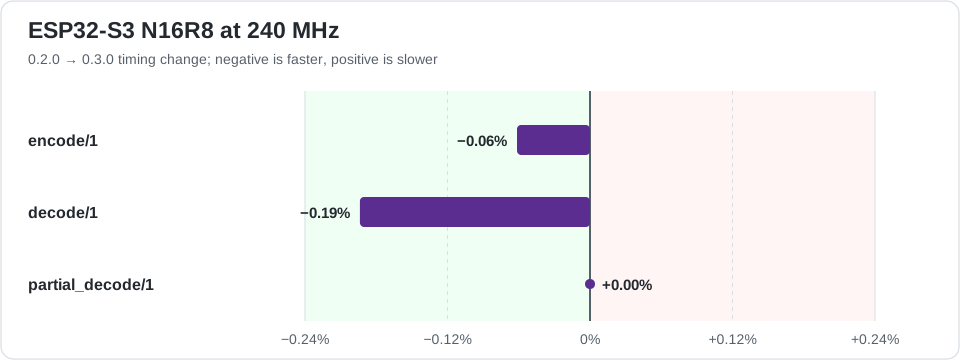
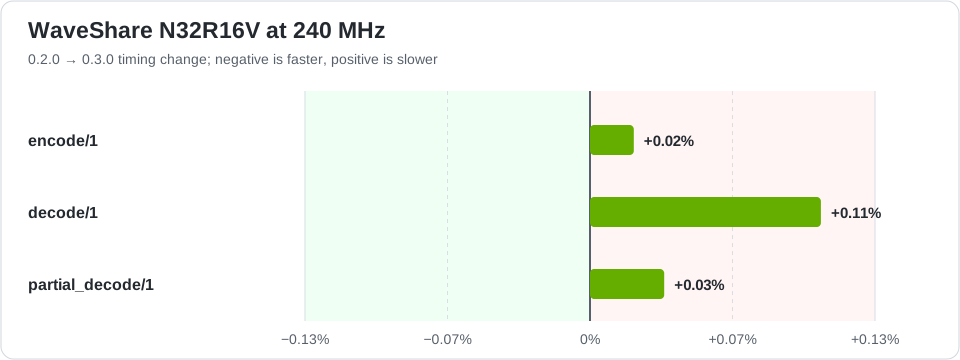
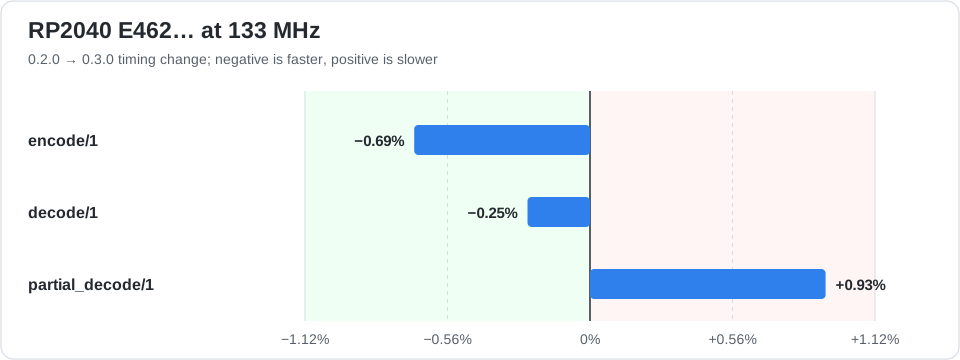
Representative attached-device benchmark changes from 0.2.0 to 0.3.0. Negative is faster; positive is slower. Static SVG labels are percentages rounded to two decimal places; exact timings follow in the benchmark table.
<!-- release-evidence:readme-current-release:end -->
## Installation
Rebar3 projects use the OTP application name `avm_cbor` and Hex package name `atomvm_cbor`:
```erlang
{deps, [
{avm_cbor, "~> 0.3.1", {pkg, atomvm_cbor}}
]}.
```
Mix projects use:
```elixir
{:avm_cbor, "~> 0.3.1", hex: :atomvm_cbor}
```
## Capabilities
- All CBOR major types, UTF-8 validation, semantic-tag passthrough, and half/32/64-bit float decode.
- Definite and bounded indefinite-length strings, arrays, and maps.
- Preferred serialization and deterministic encoding/validation under explicit options.
- Duplicate-map-key rejection and encoded-key ordering checks in deterministic decode.
- Full decode, pull-based continuation decode, complete-input decode, bounded
CBOR sequence encode/decode/fold, and deferred partial decode.
- Single-pass partial map/array folds, selective map lookup, and indexed array
access without deep-decoding unselected values.
- Depth, node, input-byte, per-string, cumulative-string, and partial-string limits.
- Structured errors for malformed, truncated, unsupported, and resource-bound inputs.
- OTP 25+ and AtomVM 0.6.6 compatibility.
## Attached-device benchmarks
The exact public `0.2.0` and `0.3.0` tags were measured on the same three
physical devices with AtomVM 0.6.6, identical firmware and harness conditions,
and five alternating paired captures. Both ESP32-S3 CPUs ran at their supported
240 MHz upper limit; RP2040 ran at its supported 133 MHz upper limit. Lower
timings are better.
<!-- release-evidence:readme-identities:start -->
| Board | Exact identity | CPU |
|---|---|---:|
| ESP32-S3 N16R8 | QFN56 rev 0.2, MAC `1c:db:d4:5b:f5:d0`, native USB identifier `1C:DB:D4:5B:F5:D0` | 240 MHz |
| WaveShare N32R16V | ESP32-S3-DEV-KIT-N32R16V, MAC `90:e5:b1:d8:48:b0`, CH340 UART serial `5B61092782` | 240 MHz |
| RP2040 E462… | RP2040 B2, BOOTSEL serial `E0C9125B0D9B`, flash ID `E46254C5C32D122C` | 133 MHz |
<!-- release-evidence:readme-identities:end -->
<!-- release-evidence:readme-summary:start -->
| Function | ESP32-S3 N16R8 0.2.0 µs | 0.3.0 µs | Change | WaveShare N32R16V 0.2.0 µs | 0.3.0 µs | Change | RP2040 E462… 0.2.0 µs | 0.3.0 µs | Change |
| :--- | ---: | ---: | :--- | ---: | ---: | :--- | ---: | ---: | :--- |
| `encode/1` | 8849.46 | 8844.02 | 0.06% faster | 3507.30 | 3508.00 | 0.02% slower | 4824.60 | 4791.26 | 0.69% faster |
| `decode/1` | 10063.52 | 10044.02 | 0.19% faster | 3931.22 | 3935.36 | 0.11% slower | 6082.16 | 6067.22 | 0.25% faster |
| `partial_decode/1` | 15575.38 | 15575.92 | 0.00% slower | 6325.48 | 6327.62 | 0.03% slower | 9261.06 | 9346.80 | 0.93% slower |
<!-- release-evidence:readme-summary:end -->
The full report publishes all 14 comparable workloads and all nine 0.3.0-only
workloads for every board, exact host results, measured accessor regressions,
device and firmware identities, three-device 40-round soak evidence, evidence
checksums, and reproduction details. See the
[0.3.1 validation report](docs/benchmarks/0.3.1.md), the original
[0.3.0 validation report](docs/benchmarks/0.3.0.md), and the
[historical 0.2.0 report](docs/benchmarks/0.2.0.md).
## Public term representation
| CBOR value | Erlang value |
|---|---|
| unsigned or negative integer | integer |
| byte string | binary |
| text string | `{text, Binary}` |
| array | list |
| map | `{map, [{Key, Value}, ...]}` |
| semantic tag | `{tag, Number, Value}` |
| boolean/null/undefined | `true`, `false`, `null`, `undefined` |
| simple value | `{simple, Number}` |
| float | float |
## Core API
```erlang
avm_cbor:decode(Binary).
avm_cbor:decode(Binary, Options).
avm_cbor:decode_all(Binary, Options).
avm_cbor:decode_sequence(Binary, Options).
avm_cbor:sequence_fold(Binary, Fun, Acc).
avm_cbor:encode(Value, Options).
avm_cbor:encode_with_size(Value, Options).
avm_cbor:encode_sequence(Values, Options).
avm_cbor:validate_all(Binary, Options).
```
`decode/1,2` consumes one value and returns `{ok, Value, Rest}`. `decode_all/1,2` requires a complete input. `decode_sequence/1,2` returns all complete sequence items and retains a truncated final item as `Rest`.
`encode_with_size/1,2` returns `{ok, Binary, Size}` from the real encode
operation. `encode_sequence/1,2` emits concatenated RFC 8742 items while
enforcing the configured item and total-byte limits. `sequence_fold/3` consumes
complete sequence items with `{cont, NewAcc}` or `{halt, Result}` callbacks.
`validate_all/1,2` validates exactly one complete item and rejects trailing
bytes without constructing its nested Erlang value.
### Pull-based continuation decode
```erlang
{ok, State0} = avm_cbor:decode_start(Binary, Options),
case avm_cbor:decode_continue(State0, Budget) of
{done, Value, Rest} -> use(Value, Rest);
{more, State1} -> schedule_next(State1);
{error, Reason} -> reject(Reason)
end.
```
`Budget` is a positive bound on explicit parser transitions. The returned state
is immutable and opaque. The decoder never sleeps or yields; event-loop pacing
belongs to the caller. This is not a streaming-input API: `Binary` must already
exist when `decode_start/2` is called.
## Partial and deferred decode
`partial_decode/1,2` validates and measures one value without eagerly constructing nested Erlang terms. It returns an opaque descriptor; callers must use the public accessors rather than matching its internal shape.
```erlang
{ok, Descriptor, Rest} = avm_cbor:partial_decode(Binary),
Type = avm_cbor:partial_type(Descriptor),
Length = avm_cbor:partial_length(Descriptor),
{ok, Value} = avm_cbor:partial_deep_decode(Descriptor).
```
Available accessors are `partial_value_bytes/1`, `partial_deep_decode/1`, `partial_skip/1`, `partial_type/1`, `partial_count/1`, `partial_tag/1`, `partial_size/1`, `partial_offset/1`, `partial_length/1`, and `partial_contents/1`.
Maps and arrays can be traversed without deep-decoding unselected values:
```erlang
{ok, MapDescriptor, <<>>} = avm_cbor:partial_decode(Binary),
{ok, ValueDescriptor} = avm_cbor:partial_map_find(MapDescriptor, Key),
{ok, Value} = avm_cbor:partial_deep_decode(ValueDescriptor).
```
`partial_map_fold/3` and `partial_array_fold/3` support `{cont, NewAcc}` and
`{halt, Result}` callbacks. `partial_select/2` finds a small requested key set
in one map pass, `partial_map_find/2` returns the first matching value
descriptor, and `partial_array_nth/2` uses a zero-based index.
## Options and limits
| Option | Default | Partial default | Purpose |
|---|---:|---:|---|
| `max_depth` | 128 | 128 | nesting depth |
| `max_items` | 4096 | 64 | global node/work budget |
| `max_bytes` | 1048576 | 1048576 | input/output bytes |
| `max_string_bytes` | 65536 | 65536 | one string or chunk |
| `max_total_string_bytes` | 1048576 | 1048576 | cumulative decoded string bytes |
| `max_string_size` | not used | 8192 | partial byte/text content |
| `allow_floats` | `true` | `true` | float support |
| `allow_simple` | `true` | `true` | simple values |
| `allow_tags` | `true` | `true` | semantic tags |
| `allow_indefinite` | `true` | `true` | indefinite-length values |
| `preferred` | `false` | `false` | preferred serialization checks/output |
| `deterministic` | `false` | `false` | deterministic encoding and strict decode validation |
Options are normalized once into fixed internal state. Recursive paths do not repeatedly scan or rebuild option proplists.
`deterministic=true` rejects indefinite-length input, non-preferred width choices, duplicate map keys, and map keys not ordered by their original encoded bytes. `ble_options/0` provides a stricter device-oriented profile.
Treat options as trusted application policy. Do not allow a network client to
raise them. Enforce the same or a smaller byte ceiling at transport ingress
before buffering the complete request, use a lower fixed profile on targets
that cannot allocate the defaults, and require empty trailing `Rest` for
protocols that permit exactly one item.
Large definite containers made entirely of preferred one-byte unsigned values
use a bounded fixed-cost path. It is independently capped at 4095 direct nodes,
so caller-raised limits cannot turn it into an unbounded speculative
allocation. Mixed, malformed, deterministic, nested, multi-byte, or larger
containers use the general bounded decoder and retain the same errors.
## Documentation and validation
- [API guide](docs/api.md)
- [Decoder policy and security limits](docs/decoder-policy.md)
- [Pinned AtomVM memory evidence](docs/atomvm-memory-internals.md)
- [Benchmark methodology](https://github.com/Atelje-Vagabond/atomvm-cbor/blob/main/docs/benchmarks.md)
- [0.3.1 validation report](docs/benchmarks/0.3.1.md)
- [0.3.0 benchmark report](docs/benchmarks/0.3.0.md)
- [Changelog](CHANGELOG.md)
Run the public validation suite:
```bash
scripts/release-check.sh 0.3.1
```
Run the reproducible host benchmark:
```bash
scripts/bench.sh
```
Benchmark values depend on the host, OTP version, and architecture. Published comparisons are measured context, not guarantees for other devices.
## License
MIT. See [LICENSE](LICENSE).