Packages
An APIac authenticator plug for API authentication using the HTTP Bearer scheme
Current section
Files
Jump to
Current section
Files
lib/apiac_auth_bearer.ex
defmodule APIacAuthBearer do
@moduledoc """
An `APIac.Authenticator` plug for API authentication using the OAuth2 `Bearer` scheme
The OAuth2 `Bearer` scheme is documented in
[RFC6750 - The OAuth 2.0 Authorization Framework: Bearer Token Usage](https://tools.ietf.org/html/rfc6750)
and consists in sending an OAuth2 access token in the HTTP request. Any party
in possession of that token can use it on the API, hence its name: 'Bearer'.
```http
GET /api/accounts HTTP/1.1
Host: example.com
Authorization: Bearer NLdtYEY8Y4Q09kKBUnsYy9mExGQnBy
Accept: */*
```
That bearer token has been granted beforehand by an OAuth2 authorization server to the
client making the API request (typically through one of the 4
[RFC6749](https://tools.ietf.org/html/rfc6749) flows or one of the 3
[OpenID Connect](https://openid.net/specs/openid-connect-core-1_0.html) flows).
Note that according to the specification, the bearer can be sent:
- in the `Authorization` HTTP header
- in the request body (assuming the request has one)
- as a query parameter
The `bearer_extract_methods` plug option allows to specify where to seek the bearer.
Bearer tokens are usually:
- opaque tokens, to be validated against the OAuth2 authorization server that has released it
- self-contained signed JWT tokens, that can be verified locally by the API
## Validating the access token
This plug provides with 2 bearer verification implementations:
- `APIacAuthBearer.Validator.Introspect` which implements
[RFC7662 - OAuth 2.0 Token Introspection](https://tools.ietf.org/html/rfc7662), and
which consists in requesting validation of the token on the authorization server
that has issued it
- `APIacAuthBearer.Validator.JWT` which implements
[JSON Web Token (JWT) Profile for OAuth 2.0 Access Tokens](https://tools.ietf.org/html/draft-ietf-oauth-access-token-jwt-07)
and which consists in locally verifying signed (and possibly encrypted)
tokens, using the cryptographic keys of the authorization server and of the current
API (using this plug)
A validator must implement the `APIacAuthBearer.Validator` behaviour.
## Caching
A bearer token may be used many times on an API in a short time-frame,
which is why caching is important
when using `APIacAuthBearer.Validator.Introspect` or a similar mechanism as a
back pressure mechanism for the authorization server. This plug comes with 4 caching
implementations:
| Caching implementation | Repository | Use-case |
|--------------------------------|:----------:|-------------------------------------------------------------------------------------------------------------------------------------------------------------|
| APIacAuthBearer.Cache.NoCache | Built-in | No caching, for testing purpose or when using a custom validator that doesn't require caching |
| APIacAuthBearer.Cache.ETSMock | Built-in | Local cache in ETS table, for testing purpose, development environment, etc. Does not have a token expiration clean-up code: the cache will grow endlessly |
| APIacAuthBearerCacheCachex | [github](https://github.com/tanguilp/apiac_auth_bearer_cache_cachex) | Production ready cache, for a single instance or a small cluster of nodes |
| APIacAuthBearerCacheRiak | Work in progress | Production ready cache, for larger clusters of nodes |
A cache implements the `APIacAuthBearer.Cache` behaviour.
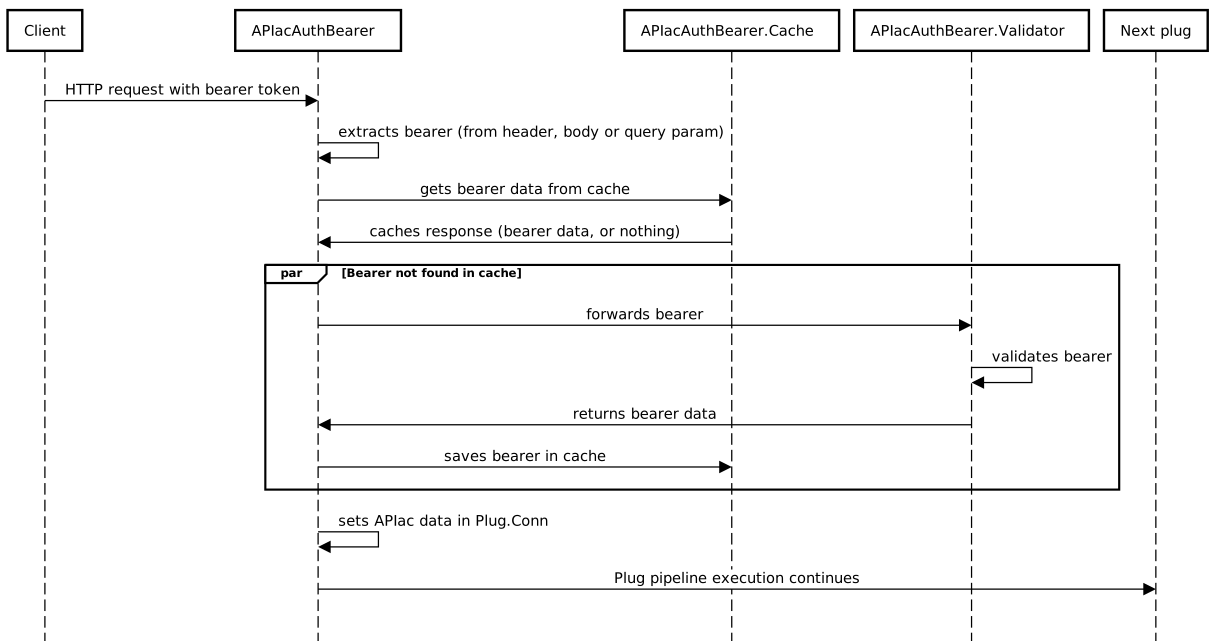
## Validation flow sequence diagram
## Plug options
- `realm`: a mandatory `String.t` that conforms to the HTTP quoted-string syntax,
however without
the surrounding quotes (which will be added automatically when needed).
Defaults to `default_realm`
- `bearer_validator`: a `{validator_module, validator_options}` tuple where
`validator_module` is
a module implementing the `APIacAuthBearer.Validator` behaviour and `validator_options`
module-specific options that will be passed to the validator when called. No default
value, mandatory parameter
- `bearer_extract_methods`: a list of methods that will be tried to extract the bearer
token, among `:header`, `:body` and `:query`. Methods will be tried in the list order.
Defaults to `[:header]`
- `set_error_response`: function called when authentication failed. Defaults to
`APIacAuthBearer.send_error_response/3`
- `error_response_verbosity`: one of `:debug`, `:normal` or `:minimal`.
Defaults to `:normal`
- `required_scopes`: a list of scopes required to access this API. Defaults to `[]`.
When the bearer's granted scope are
not sufficient, an HTTP 403 response is sent with the `insufficient_scope` RFC6750 error
- `forward_bearer`: if set to `true`, the bearer is saved in the `Plug.Conn` APIac
metadata (under the "bearer" key) and can be later be retrieved using `APIac.metadata/1`.
Defaults to `false`
- `forward_metadata`: in addition to the bearer's `client` and `subject`, list of the
validator's response to set in the APIac metadata, or the `:all` atom to forward all
of the response's data.
For example: `["username", "aud"]`. Defaults to `[]`
- `resource_indicator`: the name of the resource server as a String, to be
checked against the `aud` attribute returned by the validator. This is an optional
security mecanism for RFC7662 and mandatory for JWT access tokens. See the security
consideration sections. Defaults to `nil`, i.e. no check of this parameter
- `cache`: a `{cache_module, cache_options}` tuple where `cache_module` is
a module implementing the `APIacAuthBearer.Cache` behaviour and `cache_options`
module-specific options that will be passed to the cache when called.
The cached entry expiration ttl can be set thanks to the `:ttl` option. It is set to
200 seconds by default, but is shortened when the bearer's lifetime is less than 200
seconds (as indicated by its expiration timestamp of the `"exp"` member of bearer
metadata returned by the validator)
Defaults to `{APIacAuthBearer.Cache.NoCache, [ttl: 200]}`
## Error responses
This plug, conforming to RFC6750, responds with the following status and parameters
in case of authentication failure when `:error_response_verbosity` is set to `:normal`:
| Error | HTTP status | Included WWW-Authenticate parameters |
|-----------------------------------------|:-----------:|--------------------------------------|
| No bearer token found | 401 | - realm |
| Invalid bearer | 401 | - realm<br>- error |
| Bearer doesn't have the required scopes | 403 | - realm<br>- error<br>- scope |
For other `:error_response_verbosity` values, see the documentation of the
`send_error_response/3` function.
## Example
```elixir
plug APIacAuthBearer, bearer_validator: {
APIacAuthBearer.Validator.Introspect,
[
issuer: "https://example.com/auth"
tesla_middleware:[
{Tesla.Middleware.BasicAuth, [username: "client_id_123", password: "WN2P3Ci+meSLtVipc1EZhbFm2oZyMgWIx/ygQhngFbo"]}
]
]},
bearer_extract_methods: [:header, :body],
required_scopes: ["article:write", "comments:moderate"],
forward_bearer: true,
resource_indicator: "https://example.com/api/data"
cache: {APIacAuthBearerCacheCachex, []}
```
## Security considerations
### HTTPS
As the bearer token is sent in an HTTP header, use of HTTPS is **mandatory**
(but however not verfified by this Plug).
### Bearer methods
As stated by RFC6750, section 2:
> This section defines three methods of sending bearer access tokens in
> resource requests to resource servers. Clients **MUST NOT** use more
> than one method to transmit the token in each request.
This plug does not check whether several methods are used or not. It will
only deal with the first bearer (valid or not) found following the order
of the `bearer_extract_methods`.
### Form-Encoded Body Parameter
RFC6750, section 2.2, demands that the following conditions are met for
form-encoded body bearer access token:
> o The HTTP request entity-header includes the "Content-Type" header
> field set to "application/x-www-form-urlencoded".
>
> o The entity-body follows the encoding requirements of the
> "application/x-www-form-urlencoded" content-type as defined by
> HTML 4.01 [W3C.REC-html401-19991224].
>
> o The HTTP request entity-body is single-part.
>
> o The content to be encoded in the entity-body MUST consist entirely
> of ASCII [USASCII] characters.
>
> o The HTTP request method is one for which the request-body has
> defined semantics. In particular, this means that the "GET"
> method MUST NOT be used.
This plug, however:
- doesn't verify that the HTTP request entity-body is single-part
- the content is entirely US-ASCCI (the plug parser checks that it
is [utf8](https://github.com/elixir-plug/plug/blob/master/lib/plug/parsers/urlencoded.ex#L31)
### Audience
RFC6750, section 5.2, states that:
> To deal with token redirect, it is important for the authorization
> server to include the identity of the intended recipients (the
> audience), typically a single resource server (or a list of resource
> servers), in the token. Restricting the use of the token to a
> specific scope is also RECOMMENDED.
Consider implementing it using the `resource_indicator` parameter when using the
RFC7662 introspection validator.
### URI Query Parameter
According to RFC6750, section 2.3,:
> Clients using the URI Query Parameter method SHOULD also send a
> Cache-Control header containing the "no-store" option. Server
> success (2XX status) responses to these requests SHOULD contain a
> Cache-Control header with the "private" option.
This plug does set the `cache-control` to `private` when such a method
is used. Beware, however, of not overwriting it later unless you
know what you're doing.
"""
@behaviour Plug
@behaviour APIac.Authenticator
alias OAuth2Utils.Scope, as: Scope
alias OAuth2Utils.Scope.Set, as: ScopeSet
@default_realm_name "default_realm"
@type bearer :: String.t()
@impl Plug
def init(opts) do
realm = Keyword.get(opts, :realm, @default_realm_name)
if not is_binary(realm), do: raise("Invalid realm, must be a string")
if not APIac.rfc7230_quotedstring?("\"#{realm}\""),
do: raise("Invalid realm string (do not conform with RFC7230 quoted string)")
required_scopes = ScopeSet.new(Keyword.get(opts, :required_scopes, []))
Enum.each(
required_scopes,
fn scope ->
if not Scope.oauth2_scope?(scope) do
raise "Invalid scope in list required scopes"
end
end
)
if opts[:bearer_validator] == nil,
do: raise("Missing mandatory option `bearer_validator`")
{validator_module, validator_opts} = opts[:bearer_validator]
validator_opts =
Keyword.take(opts, [:resource_indicator])
|> Keyword.merge(validator_opts)
case validator_module.validate_opts(validator_opts) do
:ok ->
:ok
{:error, reason} ->
raise reason
end
{cache_module, cache_opts} =
Keyword.get(opts, :cache, {APIacAuthBearer.Cache.NoCache, []})
cache_opts = Keyword.put_new(cache_opts, :ttl, 200)
opts
|> Enum.into(%{})
|> Map.put(:realm, realm)
|> Map.put_new(:bearer_extract_methods, [:header])
|> Map.put_new(:set_error_response, &APIacAuthBearer.send_error_response/3)
|> Map.put_new(:error_response_verbosity, :normal)
|> Map.put(:required_scopes, required_scopes)
|> Map.put_new(:forward_bearer, false)
|> Map.put_new(:forward_metadata, [])
|> Map.put(:cache, {cache_module, cache_module.init_opts(cache_opts)})
|> Map.put(:validator_module, validator_module)
|> Map.put(:validator_opts, validator_opts)
end
@impl Plug
@spec call(Plug.Conn.t(), Plug.opts()) :: Plug.Conn.t()
def call(conn, %{} = opts) do
if APIac.authenticated?(conn) do
conn
else
do_call(conn, opts)
end
end
def do_call(conn, opts) do
with {:ok, conn, credentials} <- extract_credentials(conn, opts),
{:ok, conn} <- validate_credentials(conn, credentials, opts) do
conn
else
{:error, conn, %APIac.Authenticator.Unauthorized{} = error} ->
opts[:set_error_response].(conn, error, opts)
end
end
@doc """
`APIac.Authenticator` credential extractor callback
Returns the credentials under the form `String.t()` which
is the bearer token
"""
@impl APIac.Authenticator
def extract_credentials(conn, opts) do
case Enum.reduce_while(
opts[:bearer_extract_methods],
conn,
fn method, conn ->
case extract_bearer(conn, method) do
{:ok, _conn, _bearer} = ret ->
{:halt, ret}
{:error, conn, :credentials_not_found} ->
{:cont, conn}
{:error, _conn, _reason} = ret ->
{:halt, ret}
end
end
) do
%Plug.Conn{} = conn ->
{:error, conn,
%APIac.Authenticator.Unauthorized{
authenticator: __MODULE__,
reason: :credentials_not_found
}}
{:ok, conn, bearer} ->
{:ok, conn, bearer}
{:error, conn, reason} ->
{:error, conn,
%APIac.Authenticator.Unauthorized{
authenticator: __MODULE__,
reason: reason
}}
end
end
defp extract_bearer(conn, :header) do
case Plug.Conn.get_req_header(conn, "authorization") do
# Only one header value should be returned
# (https://stackoverflow.com/questions/29282578/multiple-http-authorization-headers)
["Bearer " <> untrimmed_bearer] ->
# rfc7235 syntax allows multiple spaces before the base64 token
bearer = String.trim_leading(untrimmed_bearer, " ")
if APIac.rfc7235_token68?(bearer) do
{:ok, conn, bearer}
else
{:error, conn, :invalid_bearer_format}
end
_ ->
{:error, conn, :credentials_not_found}
end
end
defp extract_bearer(conn, :body) do
try do
plug_parser_opts =
Plug.Parsers.init(
parsers: [:urlencoded],
pass: ["application/x-www-form-urlencoded"]
)
conn = Plug.Parsers.call(conn, plug_parser_opts)
case conn.body_params["access_token"] do
nil ->
{:error, conn, :credentials_not_found}
bearer ->
if APIac.rfc7235_token68?(bearer) do
{:ok, conn, bearer}
else
{:error, conn, :invalid_bearer_format}
end
{:ok, conn, bearer}
end
rescue
UnsupportedMediaTypeError ->
{:error, conn, :unsupported_media_type}
end
end
defp extract_bearer(conn, :query) do
conn = Plug.Conn.fetch_query_params(conn)
case conn.query_params["access_token"] do
nil ->
{:error, conn, :credentials_not_found}
bearer ->
if APIac.rfc7235_token68?(bearer) do
# RFC6750 - section 2.3:
# Clients using the URI Query Parameter method SHOULD also send a
# Cache-Control header containing the "no-store" option. Server
# success (2XX status) responses to these requests SHOULD contain a
# Cache-Control header with the "private" option.
conn = Plug.Conn.put_resp_header(conn, "cache-control", "private")
{:ok, conn, bearer}
else
{:error, conn, :invalid_bearer_format}
end
end
end
@impl APIac.Authenticator
def validate_credentials(conn, bearer, opts) do
{cache, cache_opts} = opts[:cache]
case cache.get(bearer, cache_opts) do
%{} = bearer_data ->
validate_bearer_data(conn, bearer, bearer_data, opts)
# bearer is not in cache
nil ->
case opts[:validator_module].validate_bearer(bearer, opts[:validator_opts]) do
{:ok, bearer_data} ->
try do
# let's lower the ttl when the "exp" member of the bearer's data
# says the bearer expires before the current cache ttl
exp = String.to_integer(bearer_data["exp"])
ttl = min(cache_opts[:ttl], exp - :os.system_time(:second))
cache.put(bearer, bearer_data, Map.put(cache_opts, :ttl, ttl))
rescue
_ ->
cache.put(bearer, bearer_data, cache_opts)
end
validate_bearer_data(conn, bearer, bearer_data, opts)
{:error, error} ->
{:error, conn,
%APIac.Authenticator.Unauthorized{authenticator: __MODULE__, reason: error}}
end
end
end
defp validate_bearer_data(conn, bearer, bearer_data, opts) do
metadata = if opts[:forward_bearer], do: %{"bearer" => bearer}, else: %{}
with :ok <- verify_scopes(conn, bearer_data, opts),
:ok <- verify_audience(conn, bearer_data, opts) do
metadata =
case opts[:forward_metadata] do
:all ->
Map.merge(bearer_data, metadata)
attrs when is_list(attrs) ->
Enum.reduce(
attrs,
metadata,
fn attr, metadata ->
case bearer_data[attr] do
nil ->
metadata
val ->
# put_new/3 prevents from overwriting "bearer"
Map.put_new(metadata, attr, val)
end
end
)
end
conn =
conn
|> Plug.Conn.put_private(:apiac_authenticator, __MODULE__)
|> Plug.Conn.put_private(:apiac_client, bearer_data["client_id"])
|> Plug.Conn.put_private(:apiac_subject, bearer_data["sub"])
|> Plug.Conn.put_private(:apiac_metadata, metadata)
|> Plug.Conn.put_private(:apiac_realm, opts[:realm])
{:ok, conn}
end
end
defp verify_scopes(conn, bearer_data, opts) do
if ScopeSet.subset?(opts[:required_scopes], ScopeSet.new(bearer_data["scope"])) do
:ok
else
{:error, conn,
%APIac.Authenticator.Unauthorized{authenticator: __MODULE__, reason: :insufficient_scope}}
end
end
defp verify_audience(conn, bearer_data, opts) do
if opts[:resource_indicator] != nil do
case bearer_data["aud"] do
aud when is_binary(aud) ->
if opts[:resource_indicator] == aud do
:ok
else
{:error, conn,
%APIac.Authenticator.Unauthorized{
authenticator: __MODULE__,
reason: :invalid_audience
}}
end
aud_list when is_list(aud_list) ->
if opts[:resource_indicator] in aud_list do
:ok
else
{:error, conn,
%APIac.Authenticator.Unauthorized{
authenticator: __MODULE__,
reason: :invalid_audience
}}
end
_ ->
{:error, conn,
%APIac.Authenticator.Unauthorized{
authenticator: __MODULE__,
reason: :invalid_audience
}}
end
else
:ok
end
end
@doc """
Implementation of the `APIac.Authenticator` callback
## Verbosity
The following elements in the HTTP response are set depending on the value
of the `:error_response_verbosity` option:
### `:error_response_verbosity` set to `:debug`:
| Error | HTTP status | Included WWW-Authenticate parameters |
|-----------------------------------------|:-----------:|-------------------------------------------------------------|
| No bearer token found | 401 | - realm |
| Invalid bearer | 401 | - realm<br>- error<br>- error_description |
| Bearer doesn't have the required scopes | 403 | - realm<br>- error<br>- scope<br>- error_description |
### `:error_response_verbosity` set to `:normal`:
| Error | HTTP status | Included WWW-Authenticate parameters |
|-----------------------------------------|:-----------:|--------------------------------------|
| No bearer token found | 401 | - realm |
| Invalid bearer | 401 | - realm<br>- error |
| Bearer doesn't have the required scopes | 403 | - realm<br>- error<br>- scope |
### `:error_response_verbosity` set to `:minimal`:
| Error | HTTP status | Included WWW-Authenticate parameters |
|-----------------------------------------|:-----------:|--------------------------------------|
| No bearer token found | 401 | |
| Invalid bearer | 401 | |
| Bearer doesn't have the required scopes | 401 | |
Note: does not conform to the specification
"""
@impl APIac.Authenticator
def send_error_response(conn, error, %{:error_response_verbosity => :debug} = opts) do
{resp_status, error_map} =
case error do
%APIac.Authenticator.Unauthorized{reason: :credentials_not_found} ->
{:unauthorized, %{"realm" => opts[:realm]}}
%APIac.Authenticator.Unauthorized{reason: :insufficient_scope} ->
{:forbidden,
%{
"error" => "insufficient_scope",
"scope" => ScopeSet.to_scope_param(opts[:required_scopes]),
"realm" => opts[:realm],
"error_description" => "Insufficient scope"
}}
%APIac.Authenticator.Unauthorized{reason: reason} ->
{:unauthorized,
%{
"error" => "invalid_token",
"realm" => opts[:realm],
"error_description" => Atom.to_string(reason)
}}
end
conn
|> APIac.set_WWWauthenticate_challenge("Bearer", error_map)
|> Plug.Conn.send_resp(resp_status, "")
|> Plug.Conn.halt()
end
@impl APIac.Authenticator
def send_error_response(conn, error, %{:error_response_verbosity => :normal} = opts) do
{resp_status, error_map} =
case error do
%APIac.Authenticator.Unauthorized{reason: :credentials_not_found} ->
{:unauthorized, %{"realm" => opts[:realm]}}
%APIac.Authenticator.Unauthorized{reason: :insufficient_scope} ->
{:forbidden,
%{
"error" => "insufficient_scope",
"scope" => ScopeSet.to_scope_param(opts[:required_scopes]),
"realm" => opts[:realm]
}}
%APIac.Authenticator.Unauthorized{} ->
{:unauthorized, %{"error" => "invalid_token", "realm" => opts[:realm]}}
end
conn
|> APIac.set_WWWauthenticate_challenge("Bearer", error_map)
|> Plug.Conn.send_resp(resp_status, "")
|> Plug.Conn.halt()
end
@impl APIac.Authenticator
def send_error_response(conn, _error, %{:error_response_verbosity => :minimal}) do
conn
|> Plug.Conn.send_resp(:unauthorized, "")
|> Plug.Conn.halt()
end
@doc """
Sets the HTTP `WWW-authenticate` header when no such a scheme is used for
authentication.
Sets the HTTP `WWW-Authenticate` header with the `Bearer` scheme and the realm
name, when the `Bearer` scheme was not used in the request. When this scheme is
used in the request, response will be sent by `#{__MODULE__}.send_error_response/3`.
This allows advertising that the `Bearer` scheme is available, without stopping
the plug pipeline.
Raises an exception when the error response verbosity is set to `:minimal` since
it does not set the `WWW-Authenticate` header.
"""
@spec set_WWWauthenticate_header(
Plug.Conn.t(),
%APIac.Authenticator.Unauthorized{},
any()
) :: Plug.Conn.t()
def set_WWWauthenticate_header(_conn, _err, %{:error_response_verbosity => :minimal}) do
raise "#{__ENV__.function} not accepted when :error_response_verbosity is set to :minimal"
end
def set_WWWauthenticate_header(
conn,
%APIac.Authenticator.Unauthorized{reason: :credentials_not_found},
opts
) do
conn
|> APIac.set_WWWauthenticate_challenge("Bearer", %{"realm" => "#{opts[:realm]}"})
end
def set_WWWauthenticate_header(conn, error, opts) do
send_error_response(conn, error, opts)
end
@doc """
Saves failure in a `Plug.Conn.t()`'s private field and returns the `conn`
See the `APIac.AuthFailureResponseData` module for more information.
"""
@spec save_authentication_failure_response(
Plug.Conn.t(),
%APIac.Authenticator.Unauthorized{},
any()
) :: Plug.Conn.t()
def save_authentication_failure_response(conn, error, opts) do
{resp_status, error_map} =
case error do
%APIac.Authenticator.Unauthorized{reason: :credentials_not_found} ->
{:unauthorized, %{"realm" => opts[:realm]}}
%APIac.Authenticator.Unauthorized{reason: :insufficient_scope} ->
{:forbidden,
%{
"error" => "insufficient_scope",
"scope" => ScopeSet.to_scope_param(opts[:required_scopes]),
"realm" => opts[:realm]
}}
%APIac.Authenticator.Unauthorized{} ->
{:unauthorized, %{"error" => "invalid_token", "realm" => opts[:realm]}}
end
failure_response_data = %APIac.AuthFailureResponseData{
module: __MODULE__,
reason: error.reason,
www_authenticate_header: {"Bearer", error_map},
status_code: resp_status,
body: nil
}
APIac.AuthFailureResponseData.put(conn, failure_response_data)
end
end